Best 35 Mm Camera Lens Options for Every Budget and Skill Level
Looking for a versatile 35 mm lens to cover everyday shooting, street photography, and portrait work? This guide highlights five well-rounded options across key mounts and brands. Each pick is chosen for its balance of image quality, autofocus behavior, and practical usefulness for the target photographer. Ideal buyers include enthusiast shooters upgrading from kit lenses, hobbyists wanting low-light performance, and creative storytellers seeking natural perspective without changing lenses often.
Summary of selected products:
- Canon RF35mm F1.8 IS Macro STM Lens (Canon RF, macro capable) — best for Canon EOS R series users needing a compact macro option.
- Nikon AF-S DX NIKKOR 35mm f/1.8G Lens — best for Nikon DX format shooters seeking a lightweight, sharp prime.
- YONGNUO YN35mm F2 Lens for Canon EF — best value option for Canon DSLR users on a budget.
- VILTROX 35mm f/1.7 E Mount — best for Sony E-mount APS-C users wanting bright optics and good AF.
- Fujinon XF35mmF2 R WR — best for Fujifilm X-series weather-sealed reliability and sharpness.
Canon RF35mm F1.8 IS Macro STM Lens for Canon RF

Best for Canon EOS R series shooters who want a compact, lightweight standard prime with macro capability. This lens offers 0.5x magnification and a minimum focusing distance of 0.56 ft (0.17 m), making it a practical choice for close-up subjects such as flowers or small products. The control ring enables direct setting changes for quick adjustments in dynamic shooting environments. Use this when you need a single, easy-to-carry lens that can double for macro work without swapping lenses.
Who it’s best for: photographers who prioritize macro versatility and a compact form factor within the RF ecosystem. Why selected: its macro capability adds close-focusing utility to a standard focal length, and the image quality remains strong across everyday scenes.
Caution: Macro performance improves at shorter distances; at greater distances, close-focusing benefits are reduced. Autofocus is generally reliable for everyday use but may be slower on very shallow macro shots in low light.
YONGNUO YN35mm F2 for Canon EF

Best for Canon DSLR users on a budget seeking a lightweight 35 mm prime with solid image quality. The lens covers a diagonal field of view around 63 degrees and offers a modest minimum focusing distance of 0.25 m (0.8 ft). It provides a practical balance of performance and price for everyday photography, street scenes, and travel shots. It’s a good entry point into prime lenses when building out a Canon EF kit.
Who it’s best for: budget-conscious Canon shooters needing a simple 35 mm prime. Why selected: strong value proposition with a compact build and versatile reach for casual shooting.
Caution: Build and handling may feel less premium compared with higher-end lenses; autofocus behavior can be slower in dim light compared with professional-grade options.
Nikon AF-S DX 35mm f/1.8G
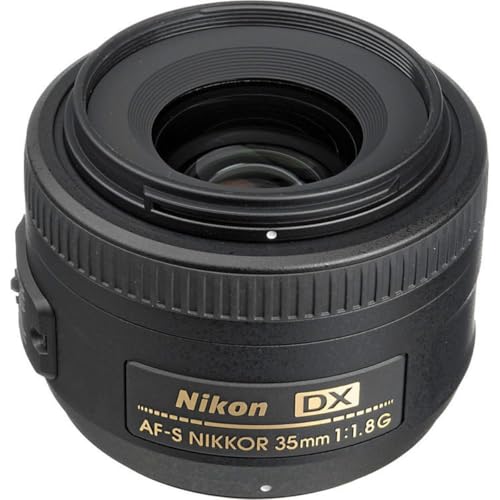
Best for Nikon DX-format bodies seeking a compact, fast standard prime with good image quality. The 35 mm focal length on DX format yields a 52.5 mm equivalent, offering a natural perspective close to a classic lens for everyday capture, portraits, and street photography. The lens features a fast aperture range of F/1.8 to F/22 and rear focusing with manual focus override for precise control. It is a reliable choice for Nikon shooters prioritizing portability and sharp results.
Who it’s best for: Nikon DSLR users needing a light, affordable prime with a classic field of view. Why selected: widely compatible with DX bodies, good low-light performance, and straightforward handling.
Caution: On FX-format bodies, this lens is not optimized for full-frame work and will not utilize the full frame’s field of view.
VILTROX 35mm f/1.7 E Mount for Sony

Best for Sony E-mount APS-C shooters who want a bright, affordable option with solid autofocus. The lens features an f/1.7 aperture, providing excellent low-light performance and natural background separation. Its optical design includes 11 elements in 9 groups with components such as HR, ED, and aspherical elements to reduce aberrations and flare, while coatings help preserve contrast in challenging lighting. This lens suits street photography, portraits, and everyday scenes where a fast prime is advantageous.
Who it’s best for: Sony APS-C photographers seeking a budget-friendly, fast 35 mm prime with reliable autofocus. Why selected: strong low-light performance and pleasing bokeh at a price point that makes it accessible to beginners and enthusiasts alike.
Caution: An APS-C camera will crop the image, so users should consider the composition impact if upgrading from a full-frame system.
VILTROX 35mm f/1.7 E for Sony ZV-E10 and More

Best for photographers who want a bright, general-purpose 35 mm prime for Sony E-mount cameras, including newer models. The lens features a large f/1.7 aperture and a focal length of 53 mm in 35 mm terms, offering a natural perspective with strong subject isolation. Its 11-element, 9-group optical design includes aspherical and low-dispersion elements to minimize distortions and flare, with a modern multi-coating to preserve contrast in bright light.
Who it’s best for: Sony shooters focusing on portraits, landscapes, and street photography who need crisp detail and smooth bokeh. Why selected: modern construction with solid optical performance at a competitive price point.
Caution: For some users, autofocus may feel slower on older Sony bodies compared with optimized native lenses; check compatibility with your camera model.
Fujinon XF35mmF2 R WR

Best for Fujifilm X-series shooters who need weather resistance and solid all-around performance. The XF35mmF2 R WR delivers a 35 mm equivalent field of view with a compact, weather-sealed design suitable for outdoor shoots in varied conditions. The inner focus system supports fast autofocus, and nano-GI coatings help minimize ghosting and flare, maintaining contrast in bright, reflective environments. This lens is a dependable everyday option for travel and street photography on Fuji bodies.
Who it’s best for: Fujifilm X users wanting reliable weather sealing and a compact, sharp prime for daily use. Why selected: robust build, good image quality, and weather resistance for outdoor work.
Caution: In very low light, the autofocus can feel less aggressive than faster glass, so plan for modest lighting or use wider apertures for better performance.
Buying Guide: 35 Mm Lenses — What To Look For
- Mount compatibility: Ensure the lens fits your camera system (Canon RF, Nikon DX, Sony E, Canon EF, Fujifilm X, etc.).
- Focal length and perspective: 35 mm on APS-C provides a 52–58 mm equivalent; on full-frame it’s a true 35 mm perspective. Consider how you shoot: street, portraits, landscapes, or macro needs.
- Maximum aperture: A larger aperture (f/1.7–f/2.0) yields better low-light performance and shallower depth of field, but may be pricier or heavier. Macro-capable lenses add versatility but can affect size and weight.
- Autofocus behavior: Native lenses generally offer smoother autofocus with your camera body. Third-party lenses can be cost-effective but may vary in speed and accuracy on different camera bodies.
- Weather sealing and build: For outdoor shooting, weather resistance can extend usability in dew, rain, or dust.
- Close focus and macro capability: If macro work is desired, prioritize lenses with close focusing distances and macro magnification.
- Image stabilization: Some RF lenses include IS; evaluate whether stabilization is important for your shooting style and typical lighting.
Frequently Asked Questions
- What is the benefit of a 35 mm lens?
It provides a natural field of view similar to human vision, good for street, documentary, and general photography. - Is a macro 35 mm lens useful for everyday shooting?
Yes, if you want close-up capability for small subjects without carrying a separate macro lens. - Should I choose a prime 35 mm or a zoom?
Primes offer typically better sharpness and wider aperture; zooms offer flexibility in framing without changing lenses. - Will a 35 mm lens on APS-C be the same as on full-frame?
No. On APS-C, it behaves like a longer focal length (about 52–58 mm equivalent or longer depending on sensor crop). - Do all 35 mm lenses have autofocus?
Most do; verify model specifics for your camera system if autofocus performance is critical. - Is weather sealing important for a 35 mm lens?
It’s beneficial for outdoor shooting and adverse conditions, but not essential for studio work.