Best 8mm Wide Angle Lens for Creative Wide Shots and Fisheye Fun
The 8mm and ultra-wide perspectives open new possibilities for landscapes, architecture, interiors, and creative video. This guide highlights five standout options that suit APS-C and Micro Four Thirds systems, covering manual focus fisheyes, zooms, and compact cinema primes. Each listing includes build quality, compatibility, and what makes it unique, helping you compare styles from circular fisheye effects to expansive ultra-wide panoramas.
| Product | Sensor Type | Mount | Key Feature |
|---|---|---|---|
| Meike 8mm F3.5 Ultra Wide Fisheye | APS-C | Canon EF | Manual focus, wide circular image on APS-C |
| Altura Photo 8mm F3.0 Fisheye | APS-C | Canon EF | 180° view, removable hood, solid build |
| Canon EF 8-15mm F4L Fisheye USM | Full-frame capable | Canon EF | Two fisheye modes, professional AF |
| OM SYSTEM M.Zuiko 8mm F1.8 Fisheye Pro | Micro Four Thirds | Micro Four Thirds | Fast aperture, weather sealed |
| Sigma 8-16mm F4.5-5.6 DC HSM | APS-C | Canon | Ultra-wide zoom, HSM for quiet focus |
Meike 8mm F3.5 Ultra Wide Fisheye

The Meike 8mm f/3.5 Ultra Wide Angle Fisheye is designed for Canon EOS APS-C cameras with EF mount. It emphasizes manual focus to control distortion and angle, producing dramatic 180-degree field-of-view effects. The lens is commonly used for artistic wide-angle shots and video with a distinctive circular or heavily vignetted horizon on smaller sensors. Lighting performance depends on aperture and how you position subjects. Users must enable M mode or mechanism to release without the lens to operate the camera with this manual lens attached.
Altura Photo 8mm F/3.0 Fisheye
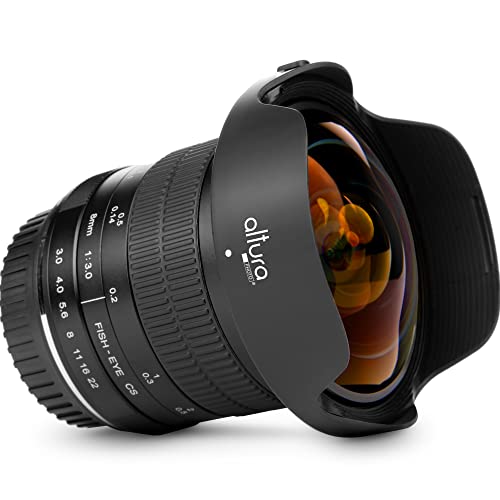
Altura Photo’s 8mm fisheye is built for Canon APS-C DSLR workflows, offering a broad 180-degree perspective in a sealed metal-and-plastic body. It’s compatible with a wide range of Canon DSLRs, including popular Rebels and 70D/80D families. The lens does best with creative wide-angle photography and video, producing strong curvature and vignette that some users enhance in post. A removable hood helps tailor the look and reduces flare in bright environments. It is not designed for Canon mirrorless R or M cameras.
Canon EF 8-15mm F/4L Fisheye USM

Canon’s EF 8-15mm f/4L USM is a professional-grade ultra-wide zoom that delivers two fisheye modes for flexible creative control. It blends L-series build quality with fast, quiet USM autofocus and strong performance in low light. The lens is suitable for studio, landscape, and architectural photography where extreme wide coverage is needed. It is designed for Canon EF-mount DSLR bodies, including full-frame cameras, and supports high-angle wide shots with minimized distortion at certain focal lengths. The lens is substantial in weight and price, reflecting its professional status.
OM SYSTEM M.Zuiko 8mm F1.8 Fisheye Pro

The Olympus M.Zuiko Digital ED 8mm F1.8 Fisheye Pro offers a fast f/1.8 aperture and weather-sealed construction, tailored to Micro Four Thirds cameras. Its bright aperture enables better subject separation in close-quarters video and stills, while the 8mm focal length provides an expansive field of view with characteristic fisheye distortion. The lens is designed for high-contrast imaging and robust build, suitable for travel, action, and creative storytelling where speed and weather resistance matter. It integrates smoothly with MFT bodies and supports modern autofocus systems, though users often prefer manual control for specific fisheye effects.
Sigma 8-16mm F4.5-5.6 DC HSM

Sigma’s 8-16mm DC HSM is a compelling ultra-wide zoom designed for Canon APS-C DSLRs. It employs FLD and aspherical elements to minimize distortion and chromatic aberrations while delivering a dramatic field of view across the zoom range. The HSM motor provides quiet, fast focusing suitable for both photography and video work. This lens is ideal for architectural interiors, landscapes, and environmental portraits where a flexible zoom range and consistent sharpness across the frame are valued. The build is robust, and the optical system supports high-contrast rendering with minimal flare when used in bright conditions.
Buying Guide: Key Considerations For 8mm Wide-Angle Lenses
- Sensor compatibility: Ultra-wide and fisheye lenses behave differently on APS-C, Micro Four Thirds, and full-frame bodies. Check how the lens renders on your camera’s sensor and whether any vignette or circular image is expected.
- Focal length and field of view: 8mm lenses give the broadest view, while zooms like 8-15mm offer flexibility. Decide between fixed focal length for consistent characteristics or a zoom for versatility.
- Aperture and speed: Fast apertures (e.g., f/1.8) improve performance in low light and provide shallow depth of field when desired, especially for cinematic work. Slower fisheyes can deliver more depth of field naturally.
- Manual vs. autofocus: Fisheye and cinema-prime lenses often rely on manual focus for precise control, while other ultra-wide lenses provide autofocus. Consider your shooting style and whether MF is acceptable for your workflow.
- Build quality and weather sealing: Outdoor use benefits from metal housings and weather sealing. For travel and videography, a rugged construction reduces wear from frequent handling.
- Image characteristics: Fisheye lenses produce intentional distortion and curvature. If you want a standard wide angle with minimal distortion, consider a rectilinear ultra-wide rather than a fisheye.
- Compatibility notes: Some lenses are designed for Canon EF, Micro Four Thirds, or other mounts and may not work with mirrorless bodies without adapters. Ensure compatibility with your camera model and any required adapters.
- Video considerations: For cinema or vlogging, look for smooth manual focus options, lens coatings to minimize flare, and efficient focusing mechanisms or silent AF where offered.
In summary, the 8mm class offers dramatic perspective and creative freedom across platforms—Canon APS-C, Canon full-frame capable, and Micro Four Thirds. Depending on whether you prefer fixed ultra-wide optics, a fast-aperture prime, or a versatile zoom, there are options that balance image quality, handling, and price. The products listed here represent common picks for enthusiasts and professionals exploring extreme-wide aesthetics while matching different camera ecosystems.