Best Black and White Camera Options for Film Photography Enthusiasts
Looking for a dependable black and white camera experience? This guide highlights five top disposable and compact film cameras best suited for beginners, hobbyists, and travelers who want classic monochrome photos without complex settings. Each option is evaluated for ease of use, exposure range, and film compatibility. The top picks favor reliability, strong B&W aesthetics, and built-in flash where available. Use the quick comparison table below to decide which fits your shooting style, from street photography to portraiture in low light.
| Product | Type | Best For |
|---|---|---|
| Ilford Photo Single Use Camera HP5+ 135 24+3 Exp | Single-use camera | General street and portrait work |
| Kodak Tri-X 400TX Professional Black & White Film ISO 400, 35mm, 24 Exposures (3 Pack) | 35mm film pack | Photographers who want flexibility and classic grain |
| 2 Pack of Kodak Tri-X 400 B&W Single-Use Flash Camera | Disposable camera with built-in flash | Traveling and events with quick results |
| Ilford XP2 Super Single Use Camera with Flash | Single-use with flash | Low-light street photography |
| Kodak T-Max 100 Speed Black and White Film TMX 135-36 Exposures | 35mm film | Detail-rich landscape and studio work |
Ilford Photo Single Use Camera HP5+ 135 24+3 Exp

This disposable camera uses HP5 PLUS 400 ISO film, offering a classic silver-to-contrast black and white look with a focus range from 1 meter to infinity. It’s best for beginners who want straightforward use and reliable results for street scenes and portraits. Choose this if you prefer strong contrast and a traditional B&W aesthetic without post-processing. Caution: fixed-focus design means you won’t adjust focus for close-up macro shots.
Kodak Tri-X 400TX Professional Black & White Film 24 Exposures (3 Pack)
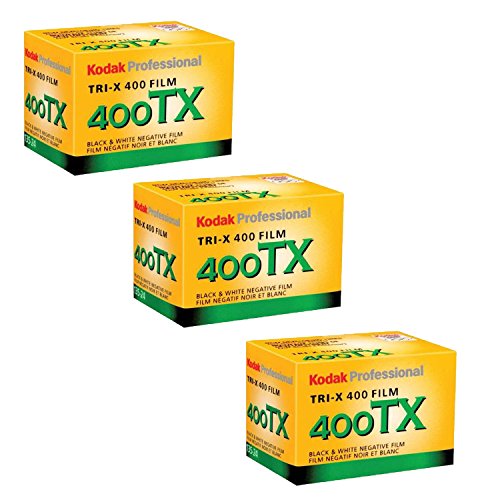
This 3-pack contains 35mm Tri-X 400 films known for fine grain and high sharpness, with a medium contrast and wide latitude. It’s ideal for photographers who want reliable development outcomes and classic documentary textures. Best for photographers who shoot in varying light and want a versatile film that can push or pull for different effects. Limitation: as a film stock, it requires a camera and processing step—no instant results on site.
2 Pack of Kodak Tri-X 400 B&W Single-Use Flash Camera

These disposable cameras come with built-in flash and deliver 27 exposures per camera. They’re best for quick, low-effort captures in dusk or indoor settings where light is limited. Use this option if you want a simple, compact solution for events or travel. Caution: flash performance and exposure can vary with distance and subject, so some trial shots may be needed.
Ilford XP2 Super Single Use Camera with Flash

XP2 Super uses ISO 400 film with a built-in flash and a fixed-focus lens, designed for straightforward shooting from 1 meter to infinity. This option is well-suited for travelers and casual shooters who want dependable results in a variety of lighting conditions while preserving strong B&W tones. Limitation: as a disposable unit, it offers limited control over exposure settings.
Kodak T-Max 100 Speed Black and White Film TMX 135-36 Exposures

T-Max 100 is a classic fine-grain film known for high sharpness and smooth tonal range, ideal for landscapes and studio scenarios where detail is critical. Best for photographers who want a clean, crisp black and white look with wide tonal separation. Caveat: lower ISO means more light is required or longer exposures in dim environments, so it’s less forgiving in low light without a tripod.
Buying Guide
What should I look for in a black and white film option?
Consider film speed (ISO), grain structure, and contrast. Higher ISO like 400 provides more latitude in mixed lighting and faster shutter speeds, while 100–125 offers finer grain and greater detail in bright light.
Disposable vs. reusable cameras—what’s the difference?
Disposable cameras are convenient for travel and events, with fixed focus and often built-in flashes. Reusable 35mm film packs (or single-use with more control) allow more consistent results and more creative options, such as choosing different films for various textures.
How does lighting affect black and white film results?
Bright, even lighting emphasizes tonal range and contrast in B&W images. Low light with higher ISO films increases grain, which some shooters prefer for a vintage look. Using a flash can help balance exposure in indoor scenes.
Which film stock should I choose for urban photography?
Tri-X 400 delivers classic grain and broad latitude, making it versatile for urban scenes with varied lighting. T-Max 100 offers crisp detail for architectural textures and sharp lines. XP2 is convenient for general street work with built-in versatility.
Processing considerations
Most of these options require development in a lab or with color-negative processing facilities. Black and white processing emphasizes different tonal ranges depending on the film stock.
Practical tips for beginners
- Use a fixed exposure approach with consistency to learn how film responds to light.
- Keep a small light meter or use a smartphone app to estimate exposure in unfamiliar lighting.
- Experiment with different films to understand how grain and contrast affect mood and composition.
FAQ
- Q: Are disposable cameras good for beginners? A: Yes, they are simple to use and yield consistent results without advanced settings.
- Q: Can I shoot black and white film in daylight without issues? A: Yes, but ISO 100–400 films balance brightness and noise; choose slower speeds for bright days.
- Q: Do these cameras require a scanner for digital use? A: Most can be scanned to digital images using a flatbed scanner or lab services.
- Q: Is built-in flash necessary? A: It helps in low-light situations or when you want even lighting on close subjects.
- Q: Can I reuse these film stocks in different cameras? A: Some are designed as single-use, while others are packs for standard 35mm cameras.