Best Camera Attachments for Microscope: Enhance Your Imaging Setup
Looking for a reliable way to capture high-quality images and videos through a microscope using your smartphone or computer? This guide highlights five top camera attachments that fit American buyers’ needs. Each option is selected for ease of use, compatibility, and value for its intended user—teachers, students, researchers, and hobbyists. Use the quick comparison table below to pick the best match for your equipment and goals.
Quick comparison table
- Celticbird Smartphone Camera Adapter — Best for 23.2mm tube microscopes; built-in eyepiece.
- Swift 5.0 Megapixel Digital Camera — Best for classroom demonstrations and live sharing via USB.
- LakwAr Universal Phone Adapter — Best for universal compatibility across eyepieces and phones.
- Walfront 0.5× C Mount Lens Adapter — Best for expanding field of view on CCD/digital eyepieces.
- Starboosa Smartphone Microscope Adapter Mount — Best for flexible telescope/microscope pairing and wide device compatibility.
Celticbird Smartphone Camera Adapter for Microscope Eyepiece Tube 23.2mm

The Celticbird adapter fits microscopes with a 23.2mm optical tube or eyepiece barrel and supports a wide range of phone widths from 2.2″ to 3.9″. It includes a built-in WF16X eyepiece for quick imaging. Best for users who want a simple, all-in-one solution on standard 23.2mm setups, especially educators or students who value a compact, ready-to-use kit. A potential limitation is to verify the exact inner diameter of your microscope tube before purchase.
Who this is for: Teachers and student labs needing a straightforward, ready-to-use smartphone capture for common 23.2mm eyepieces.
Why chosen: It provides an integrated eyepiece and phone adapter in one unit, reducing the number of separate components and alignment steps.
Caution: Measure your microscope’s internal tube diameter to ensure compatibility with this standard 23.2mm mount.
Swift 5.0 Megapixel Digital Camera for Microscopes

The Swift camera offers a 5-megapixel digital eyepiece that connects via USB 2.0 and works with Windows and Mac. It’s ideal for lecturers and clinicians who need to share color images or livestream videos to larger audiences. It supports color photography and video and integrates with standard computer platforms for easy viewing and saving. A limitation is that performance depends on computer software compatibility and USB throughput.
Who this is for: Instructors and clinicians who regularly present microscope imagery to students or colleagues.
Why chosen: A budget-friendly yet capable option for real-time sharing and archiving images or videos in classroom or lab settings.
Caution: Verify software compatibility with your operating system version to avoid driver or capture issues.
LAKWAR Telescope Phone Adapter
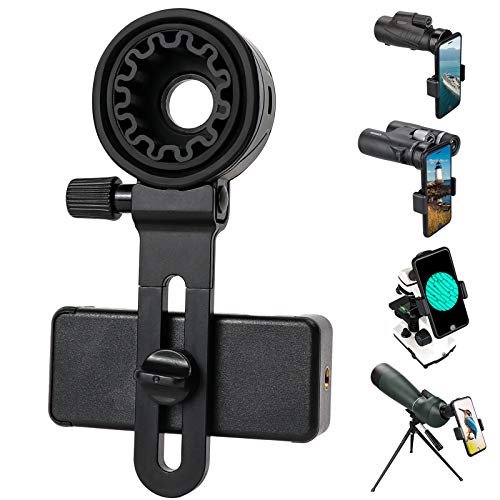
LAKWAR’s universal phone mount is designed to fit a broad range of eyepieces with 28mm-49mm outer diameter and supports devices from 65mm to 105mm in width. Easy one-minute setup helps you align the eyepiece and phone camera quickly. It’s compatible with binoculars, monoculars, microscopes, spotting scopes, and telescopes. Better for users who own multiple optical devices and want one mount to cover many scenarios.
Who this is for: Amateur astronomers and educators who need a versatile, quick-setup adapter for various optics and phones.
Why chosen: The broad eyepiece and phone compatibility provide flexibility across different instruments without buying separate adapters.
Caution: Ensure your phone’s width falls within the provided range; some very large or very small devices may require a different clamp.
Walfront Microscope Adapter 0.5× C Mount Lens

This 0.5× C-mount adapter expands the field of view by providing a wider capture area when attached to a microscope camera or digital eyepiece. The lens is designed with a blue anti-reflective coating to improve transmittance and clarity. It is compact, minimizing insertion depth, and offers a reliable build suitable for research or teaching settings. A limitation is that performance depends on the quality of the connected camera and the microscope’s C-mount interface.
Who this is for: Users seeking to enlarge the observable field for documentation or teaching demonstrations.
Why chosen: The 0.5× lens helps when you need more context in each frame, especially during collaborative lessons or demonstrations.
Caution: Confirm the C-mount compatibility with your existing camera system before purchasing.
Starboosa Smartphone Microscope Adapter Mount

The Starboosa adapter offers a universal phone mount designed for microscope, telescope, or monocular use. It fits a wide range of phones (iPhone, Samsung, HTC, LG, and others) and supports eyepiece diameters in the 22mm–44mm range. It is a flexible choice for users who want to attach a variety of devices to multiple optical platforms. A limitation is that strength and stability may vary with heavier devices or higher magnifications.
Who this is for: Researchers and hobbyists who rotate between devices and want a single mounting solution for different optics.
Why chosen: The broad compatibility makes it a practical option for households or classrooms with diverse gear.
Caution: Check the eyepiece diameter on your instrument to ensure a snug fit.
Buying Guide
What type of buyer should consider a camera adapter?
Anyone who wants to capture or share microscopic images or videos without a dedicated microscope camera. This includes students, teachers, researchers, clinicians, and hobbyists who rely on smartphones or computers for image capture and display.
Which adapter matches a 23.2mm microscope tube?
Adapters designed specifically for 23.2mm eyepieces are the simplest to use with minimal alignment. The Celticbird option is a strong match for this setup because it includes a built-in eyepiece and a phone clamp.
What about universal compatibility?
If you own multiple instruments or devices, a universal mount (like LAKWAR or Starboosa) can save time and money. Check the device width range and eyepiece diameter to ensure a fit across your gear.
What factors affect image quality?
Key factors include the camera’s sensor resolution, the eyepiece quality, mount stability, alignment accuracy, and the software used to capture or stream. External lighting and the microscope’s optics also influence results.
How to choose between still photos and video?
For lectures and demonstrations, prefer an adapter with live video capability or easy screen sharing (USB-based cameras or camera-to-computer connections). For documentation, prioritize built-in still capture options and straightforward file management.
What are common limitations to expect?
Compatibility with phone models, uniform clip strength, and alignment precision are typical. Some adapters may not support extremes of magnification or very large phones. Always verify dimensions and mounting compatibility before purchase.
Practical buyer tips
- Measure your microscope’s eyepiece or tube diameter and your phone width to prevent fit issues.
- Prefer adapters with clear assembly instructions and stable clamps for long sessions.
- Look for products with simple alignment and locking mechanisms to avoid drift during imaging.
FAQ
- Q: Do these adapters require software to work?
A: Some use USB or direct camera connections and rely on computer software; others work as stand-alone attachable kits with integrated eyepieces. - Q: Will I be able to livestream microscope images?
A: Yes, especially with USB-connected cameras and compatible software on Windows or Mac. - Q: Are these compatible with all phone brands?
A: Most adapters support a wide range, but verify the phone width and clip range for your specific model. - Q: Can I use these with a telescope in addition to a microscope?
A: Many universal mounts are designed to fit multiple optical devices, including telescopes and monoculars. - Q: Is professional calibration needed?
A: Basic alignment is usually sufficient; more precise work may require careful adjustment for each instrument. - Q: Do these adapters affect image clarity?
A: The quality is influenced by the combination of the eyepiece, camera, and adapter, plus lighting and focus accuracy.