Best Carbon Fibre Boom Poles for Filmmaking and Broadcasting
The top picks below prioritize lightweight construction, stability, and portability for professionals and enthusiasts alike. This guide helps buyers choose the right carbon fibre boom pole based on length, durability, and handling. Ideal buyers include field reporters, filmmakers, vloggers, and audio technicians seeking clear capture with reduced fatigue.
Summary of chosen products:
| Product | Best For | Key Benefit | Approx. Length (Extended) |
|---|---|---|---|
| Deity 5-Section Extendable 8.5 Feet Carbon Fiber Boom Pole | Field recording on the go | Compact when collapsed; CNC aluminum collars for durability | 8.5 ft |
| Rode Boompole Pro Carbon Fiber Microphone Boom Arm | Lightweight studio to on-camera use | Full carbon fiber, ultra-light | 10 ft (3 m) max |
| Deity BP500 16.4ft Carbon Fiber Boom Pole | Long-reach outdoor shoots | Very long, vibration dampening | 16.4 ft |
| RAUBAY Microphone Boom Arm MA01 | Budget-friendly, portable setups | Integrated cables, lightweight carbon fiber | 9 ft |
| Andoer Handheld Microphone Boom Arm 5-Section | Versatile field recording | Five-section extendable with foam grip | 61 in |
Deity 5-Section Extendable 8.5 Feet Carbon Fiber Boom Pole

The Deity 5-Section Boom Pole extends to 8.5 feet and collapses to 27.5 inches, aiding travel and quick setup. Weighing 1.1 lbs, it minimizes fatigue during long shoots. CNC aluminum collars provide stiffness without adding excessive weight, supporting reliable performance in dynamic environments.
Best for: field reporters and run-and-gun shooters who need compact portability with dependable strength. Limitation: shorter collapsed length means slightly less packing efficiency in very tight cases compared to ultracompact alternatives.
Rode Boompole Pro Carbon Fiber Microphone Boom Arm

Rode’s Boompole Pro uses 100% carbon fiber construction and weighs about 1.2 lb when fully extended. It extends from roughly 810 mm (2’8″) to 3 m (10′), offering a compact setup for interviews or on-camera talent. Best for: lightweight studio and field work where minimal weight is crucial. Limitation: maximum reach is shorter than some long-pole models, which may require closer mic placement for distant subjects.
Deity BP500 16.4ft Carbon Fiber Boom Pole

The BP500 extends from 4.2 ft to 16.4 ft, delivering long-reach versatility for outdoor scenes and crowd coverage. Carbon fiber construction reduces operator fatigue, while added vibration dampening helps minimize handling noise in windy or busy environments. Best for: documentary shoots requiring reach without a heavy rig. Limitation: longer poles can become cumbersome indoors and require sturdy support when fully extended.
RAUBAY MA01 Microphone Boom Arm

RAUBAY MA01 features a 3-section extendable design with 1/4″ and 3/8″ screw options, and a 3.6 ft to 9 ft range. It emphasizes built-in cable management to minimize cable drag and tangling, with a lightweight 1.43 lb frame. Best for: budget-conscious productions needing clean setups with flexible height. Limitation: some users may want higher end dampening for highly sensitive audio rigs.
Andoer Telescoping Microphone Boom Pole
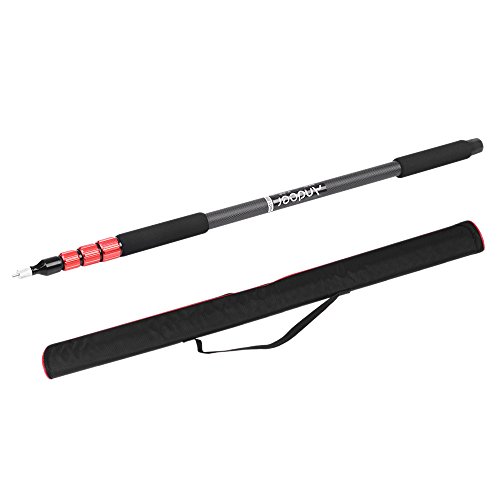
Andoer’s 4-section design extends from 36.2 inches to 118.2 inches, with a lightweight carbon fiber body and ergonomic grips. It uses twist and lock settings for stable length adjustments and aims to reduce operator fatigue during long shoots. Best for: on-location shoots requiring quick height changes and reliable grip. Limitation: some users report that longer extensions can introduce minor flex under aggressive handling.
DOBEN Telescopic Tarp Poles (67 Inches)

DOBEN’s 67-inch carbon fiber poles offer stiffness, lightness, and durability suitable for tarps, awnings, or other shelter applications. They are designed for portability with a compact form when disassembled. Best for: multi-use outdoor setups where light, rigid supports are needed. Limitation: shorter reach than dedicated microphone booms, not optimized specifically for audio capture.
Buying Guide
What length do you need? Shorter poles benefit travel and quick placement, while longer poles extend reach for distant subjects or large outdoor scenes. Consider your typical shooting distance and whether you value compact storage versus maximum extension.
Weight and balance matter. Lighter poles reduce operator fatigue but must still feel sturdy. Carbon fiber offers stiffness with minimal weight, yet some models include heavier collars for durability; balance affects mic stability and handling noise.
Cable management and attachments. Some poles include built-in cable guides or multiple screw-thread options (1/4″ and 3/8″), which helps clean setups and compatibility with mounts and shock mounts.
Rig compatibility. Check if the pole fits your existing microphone, shock mounts, and any required adapters. Longer poles may require stands or additional support to prevent sag and vibration.
Portability vs. capability. If you shoot in tight spaces, prioritize collapsible or retractable designs. For field documentaries or outdoor events, longer poles offer greater reach but demand robust transport solutions.
FAQ
- What is the main advantage of a carbon fiber boom pole? Carbon fiber delivers high strength-to-weight ratio, stiffness, and reduced transfer of handling noise, improving mobility and audio capture in dynamic environments.
- How do I choose the right length? Consider your typical shooting distance, whether you need to clear a frame, and how much space you have to move the mic. Longer poles provide more reach but are heavier and less portable.
- Is vibration dampening common in these poles? Some models offer vibration dampening features to minimize handling noise, especially in windy outdoor conditions or during moving shots.
- Can these poles support all standard mic clips? Most boom poles use standard 1/4″ or 3/8″ mounting threads, but verify compatibility with your shock mounts and adapters before purchasing.
- Do longer poles require extra support? Yes, extended lengths may require additional stabilization to prevent sagging or wobble, depending on mic weight and wind.
- Are there maintenance considerations? Keep joints clean and lightly lubricated if recommended by the manufacturer to preserve smooth telescoping action.