Best Fast Micro Four Thirds Lenses for Quick Focusing and Low-Light Shoots
Fast Micro Four Thirds lenses excel at low light, shallow depth of field, and quick autofocus. This guide highlights five versatile options that deliver bright apertures and reliable performance on MFT cameras. It’s ideal for enthusiasts and professionals alike who shoot portraits, street, or travel without carrying heavy gear. The best picks balance aperture, size, and price to fit different shooting styles and budgets.
| Product | Brand | Focal Length / Aperture |
|---|---|---|
| Panasonic LUMIX G 25mm F1.7 | Panasonic | 25mm, f/1.7 |
| 7artisans 25mm F1.8 | 7artisans | 25mm, f/1.8 |
| YONGNUO YN42.5mm F1.7M II | YONGNUO | 42.5mm, f/1.7 |
| Yongnuo YN25mm F1.7M | YONGNUO | 25mm, f/1.7 |
| OM SYSTEM M.Zuiko Digital 40-150mm F4-5.6 | OM SYSTEM | 40-150mm, f/4-5.6 |
Panasonic LUMIX G 25mm F1.7 ASPH

Best for everyday street and low-light photography. The 25mm focal length on Micro Four Thirds matches a natural 50mm equivalent, making it versatile for portraits, travel, and documentary work. The bright f/1.7 aperture provides creamy background blur and helps keep shutter speeds up in dim environments. Its compact build and lightweight profile suit minimal carry setups.
Key features: Micro Four Thirds mount, 25mm focal length, f/1.7 aperture, compact and lightweight design. Best for travelers who want a fast standard prime without bulk. A limitation is that imaging at wider angles may demand careful composition to avoid distortion at close distances.
7artisans 25mm F1.8

Best for budget-conscious photographers who want fast prime capabilities. The 25mm focal length on MFT yields a classic normal to slightly wide perspective, while the f/1.8 wide aperture delivers solid subject separation and low-light performance. The lens uses a compact, manual-focus design, suited for deliberate, thoughtful framing rather than rapid action.
Reasons to choose this: strong aperture for price, compact form, and straightforward manual focus. Caution: manual focus centering can require precise adjustment, and autofocus is not available here.
YONGNUO YN42.5mm F1.7M II

Best for portraits and low-light scenarios where a standard prime is needed with a flattering field of view. The 42.5mm focal length on Micro Four Thirds offers a comfortable portrait angle, with a fast f/1.7 aperture aiding subject separation. It is a capable budget option with auto and manual focus modes. Limitation: as a fixed prime, it lacks zoom flexibility for fast framing changes.
Why select: strong sharpness across its aperture range, compact for travel, good for candid portraits. Beat: for action or rapidly changing scenes, this fixed focal length may feel restrictive.
Yongnuo YN25mm F1.7M
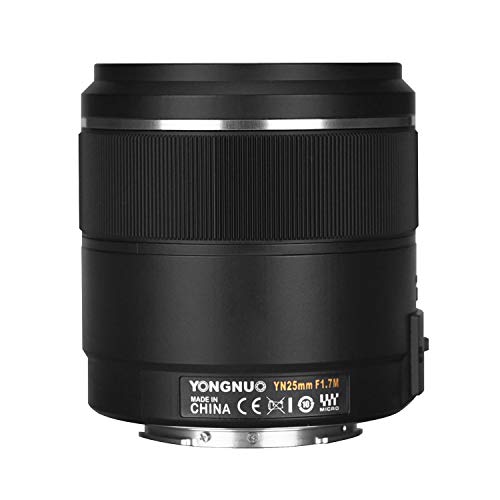
Best for versatile daily shooting, offering a 25mm focal length with a bright f/1.7 aperture. This lens supports autofocus and manual focus, making it suitable for street photography, portraits, and travel. It is a practical choice for those who want a standard wide-close perspective with reliable performance in low light.
Selected for: balanced price and brightness, easy to carry. Limitation: autofocus performance can vary by camera body, so compatibility and firmware updates may be needed for optimal results.
OM SYSTEM M.Zuiko Digital 40-150mm F4-5.6

Best for travel telephoto needs with a compact kit. The 40-150mm range covers portrait to distant subjects, while the light aperture range of f/4-5.6 keeps the lens manageable in size. It’s a practical tele zoom for Micro Four Thirds cameras, offering MSC for smoother autofocus in many shooting scenarios. A limitation is that faster apertures are not available at the long end, which affects bokeh and low-light performance.
Why choose: convenient tele range in a portable body, suitable for hiking, concerts, and street photography. Caution: not ideal in very low light without higher ISOs or stabilization in the body.
Buying Guide: Fast Micro Four Thirds Lenses
What should I look for in a fast MFT lens?
- Aperture. A larger maximum aperture (lower f-number) improves low-light performance and depth of field control.
- Focal length. Choose focal length based on your typical subjects: wide for street, normal (around 25mm) for everyday use, or tele for distant subjects.
- Autofocus behavior. If speed matters, prioritize lenses with fast AF motors (for example, Micro Four Thirds lenses with MSC or similar designs).
- Weight and size. Compact, lightweight lenses reduce fatigue on long shoots and travel days.
- Compatibility. Verify mount compatibility with your Micro Four Thirds camera body and firmware support.
How do these lenses compare for different shooting styles?
- Portraits: 25mm to 42.5mm focal lengths with f/1.7–f/1.8 apertures provide pleasing background blur and subject separation.
- Street: Fast primes like the 25mm and 42.5mm options help capture candid moments in varied lighting.
- Travel: Compact primes reduce gear weight while offering versatile focal coverage for landscapes and daily life.
- Video: Lenses with smooth AF transitions and lightweight design support steadier handheld footage.
FAQ
- What is the advantage of a fast lens on Micro Four Thirds?
- Which lens is best for portraits on MFT?
- Do fixed focal length lenses limit creativity?
- Is in-lens stabilization necessary for fast primes?
- Are these lenses compatible with all Micro Four Thirds cameras?
- What should I consider when choosing between 25mm and 42.5mm?
Fast lenses (low f-number) improve low-light performance and enable shallower depth of field in a smaller sensor system.
Focal lengths around 25mm to 42.5mm with apertures of f/1.7 to f/1.8 are well-suited for flattering portraits with subject isolation.
Fixed focal lengths encourage deliberate framing and can be lighter and cheaper, but they limit zoom versatility in fast-changing scenes.
In-lens stabilization helps in low light, but many MFT bodies offer some stabilization. For tele or dim conditions, stabilization is beneficial.
These lenses are designed for Micro Four Thirds mounts and should work with compatible Panasonic, Olympus, and OM SYSTEM bodies, subject to firmware support.
25mm yields a standard field of view, great for general use, street, and travel. 42.5mm offers a tighter portrait perspective and different composition opportunities.