Best High-Quality Cameras for Photography: Top Picks for Every Level
Answering what to buy for reliable, high-quality photography, these cameras cover beginners to advanced creators. The list highlights models with strong image quality, versatile lenses, and solid video capabilities. The top picks are suited for travel, portraits, landscapes, and daily vlogging, helping you choose based on your needs and budget.
The following table summarizes the five chosen products, including what each is best for and a quick note on their strengths and limitations.
| Product | Best For | Key Strength |
|---|---|---|
| Canon EOS Rebel T7 DSLR Camera Double Zoom Lens Kit | Beginner photographers seeking a solid entry into DSLR with two versatile lenses | 24.1 MP sensor, built-in Wi‑Fi, eye detection AF |
| Canon EOS R100 Mirrorless Camera Kit | Creatives wanting a compact system with 4K video | 24.1 MP APS-C, lightweight, interchangeable lenses |
| KODAK PIXPRO FZ55-RD | Casual shooters needing simplicity and portability | 16 MP, 5x optical zoom, Full HD video |
| NBD 5K Digital Camera | Vloggers and enthusiasts seeking high-res 5K video and macro options | 5K/64MP capability, 16x zoom, flip screen |
| 8K Digital Camera, 88MP With Dual Lenses | Advanced creators pursuing ultra-high resolution and 8K video | 88MP sensor, 8K video, dual lenses |
Canon EOS Rebel T7 DSLR Camera Double Zoom Lens Kit

Best for entry-level photographers who want a complete kit. This Canon T7 kit includes two versatile zoom lenses (18-55mm and 75-300mm), a 24.1 MP APS-C sensor, and built-in Wi-Fi with NFC. It supports a broad ISO range (100–6400, with H up to 12800) for varied lighting, and features a 9-point AF system and AI Servo AF for tracking. The included lenses offer a ready-to-use setup for landscapes, portraits, and travel photography.
Who it’s best for: Beginners who value a straightforward, all-in-one package with wide lens coverage and easy wireless sharing. Why selected: Strong baseline image quality with practical lens versatility and reliable autofocus for new shooters. Caution: Lacks in-body image stabilization, so steady handling or a tripod is recommended in low light or when using longer focal lengths.
Canon EOS Rebel T7 DSLR Camera with Kit

Best for learners upgrading from basic point-and-shoot, with a comprehensive bundle that includes a shoulder bag and a 64GB card. The T7 delivers a 24.1MP APS-C sensor and DIGIC 4+ image processor, providing clean images with intuitive automatic settings ideal for beginners transitioning to DSLR photography. Built-in Wi-Fi and NFC enable quick sharing and remote shooting via compatible devices.
Who it’s best for: New photographers who want an affordable, all-in-one starter kit with ample storage and easy connectivity. Why selected: Clear image quality, beginner-friendly controls, and a bundled setup that minimizes extra purchases. Caution: The kit’s autofocus performance is solid but not the fastest for action shots or fast-moving subjects.
Canon EOS R100 Mirrorless Camera Kit

Best for users seeking a compact system with 4K video and interchangeable lenses. The R100 uses a 24.1 MP APS-C sensor and Canon’s DIGIC 8 processor for solid performance in both stills and video. Its lightweight body makes it ideal for travel and everyday carry, while Wi-Fi and Bluetooth enable easy sharing and remote control. The kit is a strong choice for creators transitioning to mirrorless performance.
Who it’s best for: Creators prioritizing portability and modern features in a starter mirrorless setup. Why selected: Strong image quality in a compact form with 4K video; good for vloggers and travelers. Caution: Some advanced features require familiarity with Canon’s ecosystem and app workflow.
NBD 5K Digital Camera
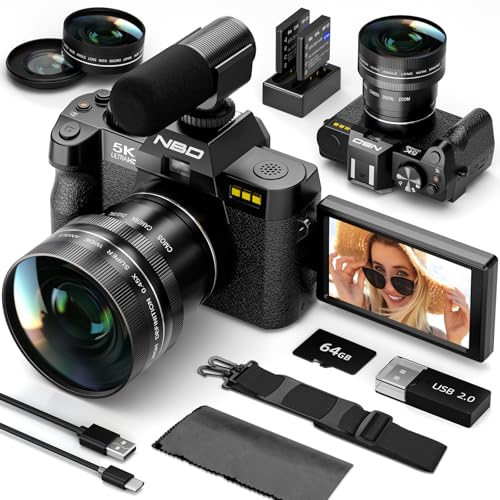
Best for enthusiasts and content creators who want high-resolution capture and flexible framing. The NBD 5K model features a 64MP sensor, 16X zoom, and a flip 180° screen, supporting 5K video and 1080p at 60fps. It includes intelligent imaging with portrait modes and dynamic tracking for moving subjects, making it a versatile option for travel and social media.
Who it’s best for: Vloggers and hobbyists who want high-resolution stills and flexible video options in one portable package. Why selected: High-resolution sensor and macro capabilities expand shooting options. Caution: The 5K label can imply higher processing demands; ensure SD storage supports large file sizes and that battery life matches shooting needs.
8K Digital Camera With 88MP Sensor

Best for advanced creators pursuing ultra-high resolution and cinematic 8K video. This camera pairs an 88MP sensor with 8K UHD recording and a 6-axis anti-shake system to minimize blur in movement. Dual lenses provide versatile shooting angles for travel, events, and full-fledged video projects. It also includes a built-in flash and two batteries for extended shoots.
Who it’s best for: Serious videographers and photographers who demand top-tier resolution and stabilization. Why selected: The combination of 8K video and 88MP stills offers expansive creative potential. Caution: The feature set is advanced; beginners may prefer more accessible options to build foundational skills first.
8K Digital Cameras for Photography (Tecglem)

Best for creators who want a flexible dual-lens setup with 8K capability and a touchscreen. The Tecglem model emphasizes rapid autofocus, a 3.2-inch IPS touchscreen, and a 16X digital zoom, making it suitable for travel and dynamic shooting contexts. Includes a 64GB card and two batteries for longer sessions.
Who it’s best for: Creators who value dual-angle shooting and easy sharing via Wi-Fi. Why selected: Strong feature mix for enthusiasts and beginners exploring high-resolution content. Caution: The learning curve may be steeper for absolute beginners when navigating dual-lens controls and advanced settings.
Buying Guide
What to consider when selecting a high-quality camera
- Sensor size and resolution: Larger sensors and higher megapixels typically yield better detail and lower noise in low light.
- Lens system and versatility: Interchangeable lenses provide greater flexibility for portraits, landscapes, and macro work.
- Autofocus performance: Look for reliable AF systems, eye-detection, and continuous tracking for moving subjects.
- Video capabilities: 4K or 8K video, frame rates, and stabilization affect feasibility for hybrid stills/video use.
- Portability vs. ergonomics: Mirrorless bodies are generally lighter; DSLRs offer robust handling and longer battery life.
- Connectivity and sharing: Built-in Wi-Fi or Bluetooth simplifies transferring files to devices and social platforms.
How to choose among the options
- Beginners: Start with a kit that includes lenses, memory card, and a bag for easy setup and learning.
- Travel and everyday carry: Prioritize compact bodies, good autofocus, and reliable battery life.
- Video-focused users: Emphasize 4K/8K capture, stabilization, and audio input options.
- Budget-conscious: Consider older generation models with solid fundamentals and a robust lens ecosystem.
Quick comparison by scenario
- Portraits and landscapes: Canon Rebel T7 and R100 both offer strong image quality with accessible workflows.
- Vlogging and social media: NBD 5K and 8K options provide flexible video features and flip screens.
- Compact travel setup: Canon R100 stands out for portability, while Kodak PIXPRO remains a simple, affordable pick.
FAQ
- What is the difference between a DSLR and a mirrorless camera? – DSLRs use optical viewfinders and typically longer battery life; mirrorless cameras are more compact and offer live view with electronic viewfinders.
- Do high-resolution cameras always take better photos? – Higher resolution helps with cropping and large prints, but sensor quality, lenses, and processing also determine overall image quality.
- Is 4K or 8K video better for beginners? – 4K is generally more approachable and widely supported; 8K offers future-proofing but requires more storage and processing power.
- Should I buy a kit with zoom lenses or buy primes separately? – Zoom kits are versatile for beginners; primes offer sharper images and wider apertures but require changing lenses for different scenes.
- What features matter most for travel photography? – Portability, battery life, quick autofocus, and reliable image stabilization are key factors.
- Are these cameras good for beginners and still useful for advanced users? – Yes, many offer scalable features; beginners can start auto and manual modes and grow into advanced settings over time.