Best Industrial Endoscope Inspection Camera for Tight Spaces and Tough Inspections
For buyers needing to inspect confined areas, invest in an industrial endoscope with a flexible, articulating probe, bright illumination, and a clear display. This guide highlights five strong options and explains who each is best for. The top picks cover automotive, plumbing, HVAC, and general dry-wall or wall-structure inspections. The summary table below helps compare key capabilities at a glance.
| Product | Best For | Key Benefit |
|---|---|---|
| Teslong Two-Way Articulating Borescope | Automotive and mechanical inspections | Two-way articulation with a 4.5″ IPS screen |
| Endoscope Camera with Light (TGJOR) | Plumbing and sewer tasks | Dual-lens with 16.4 ft waterproof probe |
| DEPSTECH Inspection Endoscope | General HVAC and plumbing | Dual lens with split screen and 4-hour battery |
| CTEOUNPT Endoscope Camera | Android/iOS inspections | 8 LEDs, IP67, semi-rigid 16.4 ft |
| DXZtoz Two-Way Articulating Borescope | Engine and mechanical spaces | 220° two-way articulation with 1080P monitor |
These products are suited for buyers such as automotive technicians, HVAC professionals, plumbers, and DIY enthusiasts who frequently inspect inside walls, pipes, engines, ducts, and other hard-to-reach areas. The selections emphasize ease of use, image clarity, and reliable durability in wet or tight environments.
Teslong Two-Way Articulating Borescope

Best for: Automotive maintenance and engine inspections where access is restricted. This borescope features a flexible, semi-rigid 5-foot gooseneck and a 4.5-inch IPS color screen for clear real-time viewing. Its two-way articulation allows turning and steering around corners or obstructions, improving inspection speed and accuracy. The device provides crisp visuals without relying on a smartphone app, which is convenient in shop environments.
Why selected: The combination of two-way articulation and a dedicated display is ideal for mechanics who need reliable, stand-alone imaging in tight engine bays or behind dashboard components. The 5-foot probe length balances reach with maneuverability. Caution: The flexible probe may drift if not guided steadily in very small crevices; best used with controlled movements.
Endoscope Camera With Light TGJOR

Best for: Plumbing and sewer inspections where wide-angle visibility and deep probing are needed. This model offers a 5″ screen with 1080P clarity and a 16.4-foot semi-rigid cable that can bend to reach tight pipes. The dual-lens capability allows switching between front and side views for comprehensive assessments. Note: It cannot capture pictures or videos, so use for live inspection and reference only.
Why selected: The dual-lens view enhances detection in complex pipe routes, and IP67 waterproofing supports wet environments. Caution: No image capture means you’ll need alternative methods for recording findings during inspections.
DEPSTECH Inspection Endoscope With Light
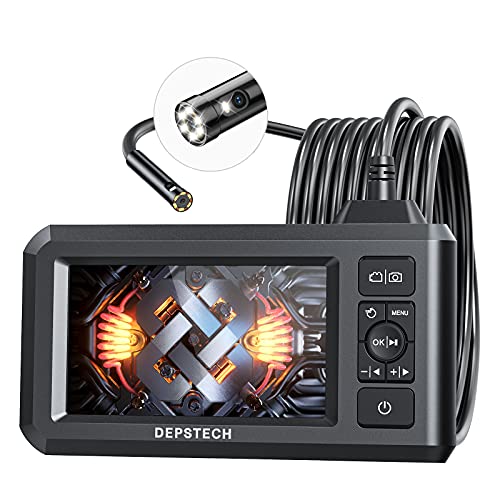
Best for: HVAC duct work and general mechanical inspections requiring a clear split-screen view. Features include dual lenses with a 70° field of view providing broad visibility, a 4-hour battery, and 1080P video with a 170° horizontal viewing angle. The 2nd CMOS chip helps reduce frame delay for smoother playback. Caution: Some users may find the screen size small in bright outdoor conditions; shade the screen when working in sunlight.
Why selected: The dual-lens and split-screen setup supports quick orientation in tight spaces, while the long cable adds reach for ducts and behind equipment. Choose this if you want an all-purpose tool with robust imaging and enough battery life for longer inspections.
CTEOUNPT Endoscope Camera

Best for: Android and iOS users who want wide compatibility with a rugged, IP67-protected, semi-rigid 16.4-foot probe. The 8 adjustable LEDs and 1920P-like clarity support detailed inspections in wet or dirty environments. The plug-in design reduces setup complexity for field work. Caution: Some devices may require the included adapters for full compatibility with certain phones.
Why selected: This option emphasizes device compatibility and reliability in damp settings such as water lines or damp walls. Choose this if you want a broad ecosystem fit and a longer probe for deep spaces.
DXZtoz Two-Way Articulating Borescope

Best for: Engine compartments and tight spaces where precise steering is essential. This model features a 220° two-way steering lens and a 4.3-inch HD IPS monitor. The 8.5mm camera and 2.0MP sensor deliver sharp close-ups, with 8 LED lights for brighter inspection in dark areas. Caution: 220° articulation can take practice to master in very confined spaces.
Why selected: The sharp articulation angle and dedicated monitor provide enhanced control when navigating around engine components, valves, and electrical work inside walls. Choose this if you need extensive maneuverability and a true stand-alone display.
Kinpthy Endoscope With Light

Best for: Home inspectors and hobbyists performing sewer, wall, or duct inspections with a bright 1920P-like display and IP67 waterproof probe. The 16.4-foot semi-rigid cable offers flexibility with rigidity for easier routing. Note: The product description mentions image capture limitations, so verify needs before purchase.
Why selected: The solid display and waterproof design support frequent use in wet or dusty environments. Choose this if you want a versatile tool for multiple inspection tasks around the home or in basic professional settings.
Buying Guide: Key Purchase Considerations
What space will you inspect most often?
Choose a longer, semi-rigid cable for ducts, walls, and pipes; select a shorter, more flexible probe for engine bays and small crevices.
Do you need a standalone display or smartphone connectivity?
Standalone displays simplify field use and reduce device warming in hot environments. Smartphone-enabled models offer portability but rely on apps and device compatibility.
Is waterproofing a priority?
IP67 or better is important for wet environments such as sewers, drains, or submerged inspections.
What image quality and lighting are required?
Higher resolution sensors (1080P) with adjustable LEDs improve detection of cracks, corrosion, and blockages in low light.
Do you need dual lenses or a single lens?
Dual-lens models provide more viewing angles; single-lens devices are often more straightforward and lighter for simple inspections.
Battery life and power considerations
Battery life matters for extended inspections in the field. Look for models advertising several hours of operation and easy USB charging options.
FAQ
- What is an industrial endoscope used for?
Used to inspect hard-to-reach spaces such as engine bays, pipes, ducts, and inside walls to identify blockages, cracks, corrosion, or component wear.
- Do all endoscopes require an app?
No. Some models operate as standalone devices with built-in screens, while others connect to phones via USB or Bluetooth.
- Is IP67 waterproofing sufficient for sewer work?
IP67 is generally suitable for temporary immersion and damp environments, including some sewer tasks, but never rely on a single spec for prolonged submersion.
- What should I consider for engine inspections?
Articulation range, probe rigidity, camera resolution, and lighting are key to accessing ignition regions, valves, and cylinders without damage.
- How long should a probe be?
Probe length should match the typical inspection depth; common ranges are 4.5 to 16.4 feet, depending on the area being examined.
- Can these devices capture photos or videos?
Some models do not support image capture; verify this if recording inspections is a requirement for your workflow.