Best Laboratory Microscopes With Cameras for Clear, Real-Time Imaging
For students, educators, and professionals, choosing a microscope with a reliable camera helps capture high-quality images and share findings easily. This guide highlights five laboratory-grade options that pair strong optical performance with integrated or accessory cameras, making it easier to document specimens, share observations, and collaborate. Each entry covers key features, imaging capabilities, and practical use cases to help you compare effectively.
| Product | Brand | Magnification Range | Camera Type | Best For |
|---|---|---|---|---|
| Trinocular Microscope 40X-5000X | Woehrsh | 40X-5000X | HD USB Camera | Advanced biology work |
| Trinocular Microscope 40X-5000X (Dual Mechanical Stage) | Woehrsh | 40X-5000X | HD USB Camera | Group use, teaching labs |
| AmScope B120 Series with 5MP USB Camera | AmScope | 40X-2500X | 5MP USB Camera | Students and professionals |
| AmScope B120 Series with 1MP USB Camera | AmScope | 40X-2500X | 1MP USB Camera | Budget-conscious labs |
| Swift SW350T with 5.0 MP Camera | SWIFT | 40X-2500X | 5.0 MP Camera | Classrooms and clinics |
| TOMLOV DM301 Pro Digital Microscope | TOMLOV | Up to 1200X | Integrated 7″ Screen (WiFi camera app) | Hands-on digital learning |
| Woehrsh 40X-2000X With USB Camera | Woehrsh | 40X-2000X | USB Camera | Home education and labs |
Trinocular Microscope 40X-5000X With Dual Mechanical Stage

This Woehrsh trinocular model blends a wide magnification range with a dual mechanical stage for precise slide handling. It features wide-angle WF eyepieces and a real 195 achromatic objective, designed to deliver high-resolution images across a spectrum from 40X to 5000X. The built-in LED illumination, dual coarse and fine focus controls, and adjustable pupil distance support prolonged observation sessions. An HD USB camera enables capture of sharp images and video, ideal for documenting specimens in academic or professional labs.
Trinocular Microscope 40X-5000X With HD Camera — Variation

This alternate Woehrsh offering mirrors the core features of the first model, emphasizing a robust infinity optical system and 195 achromatic objective lenses. The 8-core design and 306° swiveling head support versatile use in classrooms and labs. The LED illumination and dual coaxial focusing enable fine detail at high magnifications, while the USB camera provides easy digital capture and sharing of observations for coursework or research tasks.
AmScope B120 Series With 5MP USB Camera
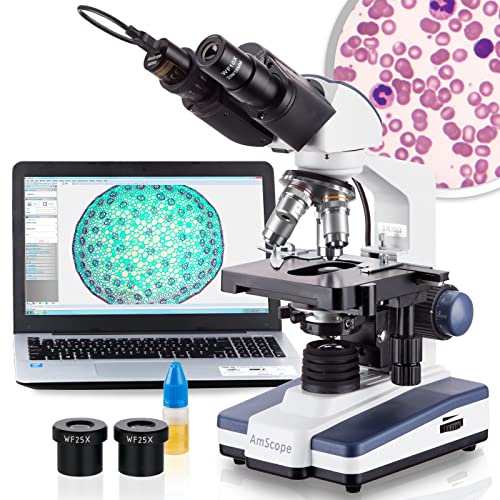
The AmScope B120 Series delivers economical, binocular compound microscopy with an LED illumination system and a high-resolution 5MP USB camera. It supports magnifications from 40X to 2500X, making it suitable for educational settings, clinics, and light research. The Fly-Eye LED arrangement provides bright, balanced illumination, helping users view cellular detail without excessive glare. Its Siedentopf head offers ergonomic viewing, which reduces fatigue during extended sessions.
AmScope B120 Series With 1MP USB Camera

This AmScope configuration offers the same reliable B120 framework with a lighter camera option. It maintains 40X-2500X magnification and LED illumination for clear slides, making it suitable for classrooms and entry-level labs. The Siedentopf head and binocular viewing enhance comfort, while the 1MP USB camera provides a straightforward path to digitizing specimens and sharing results in reports or presentations.
Swift SW350T 40X-2500X With 5.0 MP Camera

The Swift SW350T combines a trinocular head with a two-layer mechanical stage and six magnification levels (40X, 100X, 250X, 400X, 1000X, 2500X). It’s designed for shared use in classrooms or clinics, featuring a rotatable Siedentopf head and ergonomic eyepiece options. A bright LED illumination system and Abbe condenser enable strong illumination and contrast. The bundled 5.0 MP camera supports clear image capture and basic software compatibility for image analysis and documentation.
TOMLOV DM301 Pro Digital Microscope

The TOMLOV DM301 Pro offers a digital viewing experience with a built-in 7″ IPS display and wireless control via a companion app. It supports USB and HDMI outputs for content sharing and presentation-friendly output. The camera system provides up to 1200X magnification, enabling detailed study of cells, tissues, and microorganisms. This model is well-suited for classrooms and home laboratories aiming to integrate digital documentation and remote viewing capabilities.
Woehrsh 40X-2000X With USB Camera

This Woehrsh model emphasizes a broad magnification range from 40X to 2000X and includes a USB 2.0 camera for image capture and video. The LED dual light source supports observation of a wide array of specimens under different lighting conditions. The device is designed for adults in home education, school labs, or small professional settings, offering a balance of affordability and capability with straightforward operation.
Buying Guide: Key Purchase Considerations
- Magnification range and optical quality: Look for infinity optics, achromatic objectives, and a wide magnification span (e.g., 40X-1000X or higher) to cover basic to advanced specimens.
- Camera integration: Decide between built-in cameras and external USB options. Higher megapixel cameras (5MP or more) deliver crisper images; ensure software compatibility for your PC or Mac.
- Head and eyepieces: A trinocular head supports image capture without compromising viewing comfort. Wide-field eyepieces (10X, 25X) help reduce eye strain during long sessions.
- Illumination: LED lighting with adjustable intensity and an even field of illumination improves contrast and reduces glare. A fly-eye or similar diffuser can enhance imaging quality for bright specimens.
- Mechanical stage and focusing: A dual coarse/fine focus and a stable, adjustable mechanical stage improve repeatability when handling slides or prepared specimens.
- Ergonomics and build: Consider adjustable interpupillary distance, a tilting head, and a compact footprint for classroom or lab environments.
- Connectivity and data handling: For digital labs, ensure the camera supports straightforward image transfer, and check compatibility with common software or cloud workflows.
- Durability and service: Look for metal frames and robust construction for extended classroom use, with available replacement parts or service options.
In summary, the best choice depends on your application: educational settings benefit from user-friendly interfaces and reliable illumination, while research-oriented environments prioritize camera resolution, optical clarity, and precise focus controls. The models listed here cover a spectrum of budgets and capacities, providing solid pathways to document and analyze microscopic specimens with confidence.