Best Light Meter for Landscape Photography: Accurate Lux Readouts for Perfect Exposures
Get precise light readings to dial in landscapes with ideal exposure. This guide highlights five reliable light meters suited for landscape photographers, plant photographers, and field shooters. Each option offers clear Lux or FC measurements, helpful features like data hold and auto shutoff, and a design tailored to outdoor or studio work. Choose based on range, accuracy, and how you plan to use the meter in nature or on location.
| Product | Best For | Range |
|---|---|---|
| URCERI Light Meter | General landscape shooters needing ambient temp and robust Lux range | 0–200,000 Lux |
| Sekonic L-308X-U Flashmate | Hybrid stills and flash-heavy landscapes | Ambient & flash measurements |
| UNI-T UT383 | Compact, reliable readings for field work | 0–199,900 Lux |
| Ohcans Digital Illuminance Light Meter | Photography and plant lighting setups | 0–200,000 Lux |
| TTARTISAN Light Meter II | Film photography enthusiasts and vintage setups | Wide shutter/aperture control |
URCERI Light Meter With Lux & Ambient Temperature
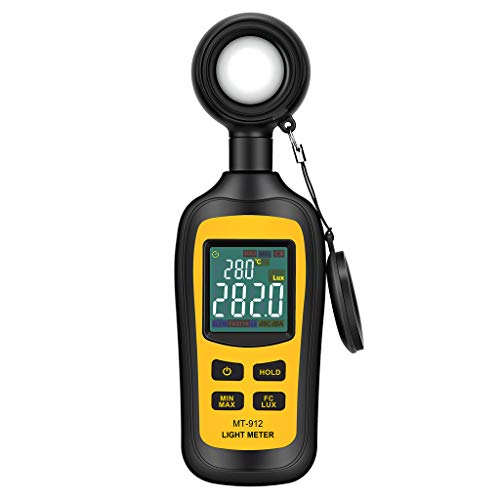
The URCERI device measures luminosity from 0 to 200,000 Lux and includes ambient temperature readings. It provides high accuracy (±3% rdg ± 8 dgts under 10,000 Lux; ±4% rdg ±10 dgts above 10,000 Lux) and features a 4‑digit color LCD, MIN/Max readings, data hold, auto power off, and a low battery indicator. Best for landscape shooters who want a single tool with environmental data for field conditions. Use this when you need combined light and ambient temperature data in one handheld unit. Caution: the device’s accuracy varies marginally at very high luminance; ensure fresh batteries for critical shoots.
Sekonic L-308X-U Flashmate Light Meter

The Sekonic L-308X-U provides precise exposure readings for ambient and flash light with tenth-of-a-stop accuracy in full-stop mode. It covers an ambient EV range and supports a broad flash range with a wide shutter-speed span, making it a strong choice for photographers who mix natural light with strobe or continuous lighting on location. Best for stills and cine work where nuanced exposure control matters. Limitations: the meter may be less intuitive for beginners and relies on ISO 100 defaults for some ranges.
UNI-T UT383 Lux Meter

The UNI-T UT383 is a compact digital illuminance meter that reads 0–199,900 Lux (0–18,500 FC) with high accuracy and a large backlit LCD. It offers MAX/MIN readings, data hold, auto shutdown, and a 0.5-second sampling time. Its compact size makes it practical for field use during landscape shoots. Best for photographers who want a reliable, easy-to-carry meter with a quick response time. Caution: the device’s auto shutdown can interrupt continuous readings if the user forgets to disable it for long sessions.
Ohcans Digital Illuminance Light Meter

The Ohcans meter covers 0–200,000 Lux with a ±4% +10 dgts accuracy. It features a 180° rotating sensor, a backlit LCD for low-light readings, and rapid 0.5-second sampling for real-time data. It supports multiple scenes, including photography, plant care, and office evaluations. Best for landscape shooters who need flexible measurement angles and readable output in dim environments. Limitation: the data is presented in Lux; if you prefer FC, conversion is required for some workflows.
TTARTISAN Light Meter II (Silver)

The TTARTISAN Light Meter II offers adjustable ISO, aperture, and shutter speed with a cold shoe mount. Its featherlight aluminum body (34 g) suits vintage film cameras and the analog photography revival. It provides precise exposure control via two dials and clear indicator lights, preserving traditional camera operation. Best for film shooters and those exploring classic setups. Caution: designed for manual exposure workflows; digital or automatic modes are not its focus.
Buying Guide: Key Purchase Considerations
What range do you need? For most landscape scenarios, 0–200,000 Lux covers standard daylight to dim shady areas. If you also work with plants or greenhouse setups, high range accuracy helps optimize photosynthesis or growth conditions. Units matter: Lux is common for photography; FC can be helpful for horticulture. Look for auto power-off to save battery in long shoots, and data hold for keeping readings during framing. A backlight display improves usability in shade or night environments. Consider whether you need ambient temperature, rotating sensors, or a dedicated flash measurement feature for hybrid lighting.
Which features drive your choice? If you mix natural light with flash or strobe, a meter with separate ambient and flash readings (like the Sekonic L-308X-U) is advantageous. For compact field work, a small form factor with fast sampling (UNI-T UT383 or Ohcans) supports quick, on-the-go readings. For film photography or vintage gear, TTARTISAN meters emphasize manual control and compatibility with classic cameras. For plant-focused shoots or integrated data, URCERI’s ambient temperature readout adds environmental context to your exposure decisions.
How should you compare meters? Prioritize accuracy figures, response times, and unit consistency (Lux vs FC). Evaluate battery indicators, data storage options (MIN/MAX/data hold), and durability in outdoor conditions. If you frequently shoot in low light, a meter with strong backlighting and a wide viewing angle reduces guesswork. Finally, ensure the device is easy to calibrate or understand so you can rely on readings without extensive setup.
Frequently Asked Questions
- What is the main purpose of a light meter in landscape photography?
To measure ambient light levels and guide exposure settings for scenes, ensuring balanced highlights and shadows.
- Should I use Lux or FC units for landscapes?
Lux is standard for photography; FC is common in horticulture. Many meters switch between units, which offers flexibility.
- How important is flash measurement for landscapes?
Not always essential, but it helps when using external lighting or when mixing daylight with artificial light sources.
- What features should I prioritize for field use?
Portability, quick sampling, backlit display, data hold, and auto power-off are especially helpful outdoors.
- Can a light meter replace a camera meter?
In many cases it supplements in-camera metering, providing objective readings that can be replicated across scenes.