Best Long Range Thermal Clip-on for Hunters and Outdoor Vision
When choosing a long-range thermal clip-on, the top goal is clear target acquisition in challenging light and weather. For long-range hunting and tactical use, these clip-ons should deliver crisp imaging, reliable rangefinding, and quick mounting to day optics. This guide highlights four top options, detailing who benefits most from each and why they were selected. It helps shooters decide who should choose which model for maximum field performance.
Buyer quick reference:
| Product | Best For | Key Benefit | Limitations |
|---|---|---|---|
| PANORA Precision TKC-350 | Serious long-range operators | High sensitivity with Super-Resolution | Higher price point |
| Athlon Cronus ATS PRO 35 C-640 | All-around thermal clip-on | Long detection with multiple color palettes | Thermal only, needs compatible scope |
| LIEMKE MERLIN-42 | Dedicated long-range hunters | Sharp 384×288 detector and detailed imagery | Pre-mounted device; may require mounting setup |
| AGM Secutor LRF-C 50-640 | Precision distance measurement | Built-in laser rangefinder with high clarity | Complex setup for new users |
PANORA Precision TKC-350 Thermal Scope

The TK-C Sirius thermal system uses a 384×288 detector and an ultra-low NETD ≤18 mK for highly detailed imagery. A 50mm objective lens and 3.2x base magnification balance long-range capability with a compact form. A 50Hz refresh rate keeps motion smooth, while Super-Resolution enhances edge clarity for sharp targets. The 1024×768 OLED screen centers visibility. This device is best for dedicated hunters and tactical users who need clear thermal detail at distance and fast target recognition.
Who it’s best for: users demanding top image clarity at range and advanced observation tools. Why selected: it combines high sensitivity with crisp display and latency-optimized imaging for precise shot placement.
Caution: the premium feature set can add weight and complexity; ensure your mounting system supports the 50mm objective and 3.2x baseline magnification for optimal results.
Athlon Cronus ATS PRO 35 C-640 Thermal Clip-On

This clip-on converts traditional day optics into thermal imaging tools, making it versatile for riflescopes you already own. It features a 12m thermal sensor with NETD better than 25 mK and a long detection reach up to 1,950 yards for improved visibility in open terrain. The OLED display provides clear, readable imaging across palettes to suit lighting conditions. It is best for shooters who want a simple upgrade path that preserves their existing sights while gaining thermal capabilities.
Who it’s best for: shooters seeking a straightforward upgrade to their daytime scope with strong long-range detection. Why selected: it offers a balance of performance and compatibility, ideal for multi-environment use.
Caution: compatibility with specific day optics varies; verify mounting compatibility and eye relief to avoid obstructions or vignetting in some setups.
LIEMKE MERLIN-42 Clip-On

The LIEMKE MERLIN-42 is a pre-mounted thermal device designed for long-range field shooting. It offers a 384×288 VOx detector with 17µm pixel pitch and a 1,024×768 OLED display for sharp imagery. The 35mm objective lens yields a broad field of view at distance, enabling detailed observation at extended ranges. This model is best for long-range hunters who want crisp, consistent imaging and a ready-to-use setup out of the box.
Who it’s best for: dedicated long-range shooters who value image detail and a fast setup. Why selected: the combination of detector quality and a large OLED screen supports precise target identification at distance.
Caution: the device is pre-mounted, which may require a specific mounting interface; verify your rifle platform and compatibility prior to purchase.
AGM Global Vision Secutor LRF-C 50-640
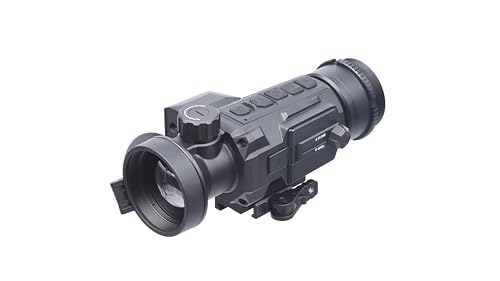
The AGM Secutor LRF-C clip-on system transforms daytime optics into a thermal imaging device with a built-in laser rangefinder. It pairs a 12μm detector with a high-resolution 1024×768 OLED display for clean imaging in complete darkness, fog, or smoke. The integrated laser rangefinder provides distance measurements up to 1000 meters, adding precise range capability to any thermal observation. This model is best for shooters who require exact distance data combined with reliable thermal imagery.
Who it’s best for: operators needing precise rangefinding integrated into thermal imaging. Why selected: the built-in rangefinder and clear display deliver actionable metrics alongside strong thermal detail.
Caution: setup may be more complex for first-time users; ensure proper alignment of the rangefinder with your target plane for accurate readings.
Buying Guide
What matters most when choosing a long-range thermal clip-on?
- Detector resolution and NETD: Higher resolution and lower NETD yield crisper images and better target separation at distance.
- Lens and magnification: A larger objective and appropriate magnification improve long-range clarity, but may add weight.
- Display quality: A bright, high-resolution OLED or LCD panel improves visibility in bright or dark environments.
- Refresh rate and latency: 50 Hz reduces motion blur; low lag is essential for moving targets.
- Rangefinding: Integrated laser or handheld rangefinders add precise distance measurement critical for long shots.
- Mounting compatibility: Ensure the clip-on attaches securely to your daytime optics without blocking reticles.
- Power and battery life: Longer operation times reduce field maintenance; check battery type and availability.
- Ease of use: Simple controls and clear menus improve quick adaptation in the field.
FAQ
- What is NETD and why does it matter?
NETD measures thermal sensitivity; lower values deliver crisper, more distinct targets at distance. - Can clip-ons work with any daytime scope?
Most clip-ons are designed to mount onto specific optics; verify compatibility with your rifle and mount. - Is a built-in laser rangefinder necessary?
It improves distance precision; models without it may rely on external rangefinders. - Do these devices require special training?
Basic operation is straightforward, but advanced image interpretation benefits from practice in varying conditions. - What factors influence detection range?
Sensor quality, lens size, atmospheric conditions, and target contrast all affect range performance. - Are these devices legal for all hunting seasons?
Regulations vary by location; check local wildlife and firearm rules before use.