Best Micro Four Thirds Fisheye Lenses for Enthusiasts and Pros
Answering the most common buyer intent: find compact, ultra-wide fisheye lenses designed for Micro Four Thirds cameras that deliver dramatic perspective with minimal bulk. This guide highlights five top options, focusing on compact form, wide field of view, and practical strengths for travel, landscape, architecture, and creative photography. Each selection is best for specific needs—compact travel kits, manual focus enthusiasts, body-cap style use, and ultra-wide creative shots.
Quick buying snapshot for quick comparisons:
| Product | Best For | Key Note |
|---|---|---|
| MEKE MK-3.5mm F2.8 Ultra Wide Circular Fisheye | Ultra-wide, circular fisheye on MFT bodies | 220° diagonal field of view |
| 7Artisans 4mm F2.8 Fisheye | Ultra-wide, budget-friendly travel and VR work | 225° circular angle |
| Brightin Star 10mm F5.6 Pro Fisheye (Silver) | Very compact, hyperfocal design | 175° field; travel-friendly |
| OM SYSTEM Olympus M.Zuiko 9mm F8.0 Fisheye Body Cap | Body-cap style, silent, lightweight | 9mm, manual focus |
| AstrHori 10mm F8 II Fisheye (Micro 4/3) | Ultra-wide, portable APS-C/Micro 4/3 option | 180° field, compact |
MEKE MK-3.5mm F2.8 Ultra Wide Circular Fisheye

Best for ultra-wide circular fisheye on Micro Four Thirds bodies. The Meike lens supports Olympus and Panasonic MFT cameras such as E-M1, M5, E-PL series and GH series, among others. It offers a 220° diagonal field of view, which yields dramatic perspective with edge-to-edge curvature. The aperture range is F/2.8 to F/16, enabling low-light shots and creative depth of field control. Best for photographers seeking a bold, circular fisheye look without switching to a larger full-frame lens. Potential limitation: manual focus and lack of electronic communication with some bodies may affect metering or EXIF in certain cameras.
Who it’s best for: photographers who want an aggressive fisheye look on compact MFT bodies and don’t mind manual operation. Why chosen: wide 220° FOV, relatively fast aperture, broad compatibility with popular MFT bodies.
Brightin Star 10mm F5.6 Pro Fisheye (Silver)
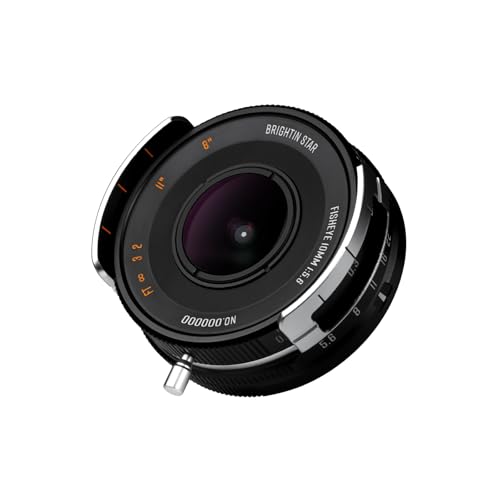
This lens delivers a compact option with a 175° ultra-wide field of view and a lightweight design that’s easy to carry for travel and street photography. Its hyperfocal distance design reduces the need to adjust focus for distant subjects, allowing quick captures. Best for: travelers and photographers who want a small fisheye with substantial perspective. Caution: some users may prefer an even wider field for certain architectural shots, as 175° is broad but not as expansive as some alternatives.
Who it’s best for: travel and urban shooters who prioritize portability with a strong creative field of view. Why chosen: compact form, hyperfocal design, and manageable weight for a pocketable setup.
OM SYSTEM Olympus M.Zuiko 9mm F8.0 Fisheye Body Cap

The M.Zuiko 9mm F8.0 is designed as a body-cap style fisheye, providing an ultra-compact option with a minimal footprint. This lens is best for photographers seeking a discreet, low-profile fisheye that preserves the native Micro Four Thirds form factor. It’s manual focus by lever, with a simple barrier function to protect the lens. Best for: photographers who want a go-anywhere fisheye that won’t alter the camera’s size or balance. Caution: body-cap designs can limit close focusing and may not suit all macro or subject-range needs.
Who it’s best for: minimalist setups and photographers who want a ready-to-use body-cap fisheye with no external bulk. Why chosen: extreme compactness, true MFT compatibility, and quick readiness for street and architectural shots.
7Artisans 4mm F2.8 Fisheye (M4/3)

The 7Artisans 4mm F2.8 is a compact circular fisheye designed for Micro Four Thirds cameras, offering a 225° ultra-wide angle. It suits landscape, VR panorama, and creative architectural shots. Aperture ranges from F/2.8 to F/16, enabling more light management in dim scenes. This lens uses a robust construction with a lightweight frame. Best for: budget-conscious buyers who want a very wide fisheye without stepping up to higher-priced options. Limitation: manual focus and non-electronic communication can affect metering on some bodies.
Who it’s best for: VR and panoramic shooters who want a strong fisheye presence on a budget. Why chosen: broad 225° field, compact build, and modern optics with chromatic aberration control via additional ED elements in some versions.
AstrHori 10mm F8 II Fisheye (Micro 4/3)

The AstrHori 10mm F8 II is a compact fisheye option compatible with Micro Four Thirds cameras, offering about 180° field of view. It emphasizes portability with a slim, all-metal body and multi-coating. A filter slot allows UV and other filters, expanding creative control. Best for: photographers who want an ultra-wide, light lens with filter compatibility for outdoor use. Caution: some users may prefer lenses with brighter apertures for low-light work, as F/8 is relatively stopping-down friendly but not fast.
Who it’s best for: outdoor shooters and compact-kit fans who want a lightweight option with filter capacity. Why chosen: balance of wide FOV, portability, and build quality with practical filter use.
Buying Guide: Key Considerations For Micro Four Thirds Fisheye Lenses
- Field of view and type: Decide between ultra-wide circular fisheye versus standard full-frame-like fisheye with circular images. Circular fisheyes are often more dramatic for creative portraits and VR work, while linear fisheye styles emphasize architectural curvature.
- Mount compatibility and body features: All listed lenses are designed for Micro Four Thirds. Check whether the lens is native, requires manual focus, or uses a body-cap design, affecting handling and focus control on your camera.
- Size, weight, and portability: For travel and street work, a compact option like the OM System body-cap or the 7Artisans 4mm can significantly reduce kit weight and size.
- Aperture and light gathering: Wider apertures (e.g., F/2.8) provide more light but can complicate depth of field at very wide angles. Hyperfocal designs help with quick shooting at infinity in bright settings.
- Filter compatibility: Some models offer filter slots to enable UV/ND/CPL filters. This is useful for landscapes and urban photography in varied lighting.
- Manual vs. electronic control: Many fisheye options on MFT rely on manual focus. Consider how this aligns with your workflow, particularly if you rely on metering and exposure automation.
- Creative use cases: Fisheye lenses are ideal for VR panoramas, architectural exaggeration, space perception, and stylized photography. Consider your primary projects to pick the right FOV and build.
FAQ
- Q: Do these lenses work on all Micro Four Thirds cameras? A: Yes, all listed options are designed for Micro Four Thirds mounts and should fit Olympus and Panasonic MFT bodies. Some may require manual focus depending on the camera model.
- Q: What is the best lens for travel? A: The Brightin Star 10mm F5.6 Pro Fisheye offers a very compact profile with a substantial field of view, making it well-suited for travel photography where weight matters.
- Q: Which lens provides the widest angle? A: The MEKE MK-3.5mm F2.8 and 7Artisans 4mm F2.8 offer among the widest angles in this selection, with diagonal FOV around 220–226 degrees in circular fisheye designs.
- Q: Are body-cap fisheye lenses practical? A: Body-cap fisheyes like the OM SYSTEM M.Zuiko 9mm F8 are extremely portable and quick to deploy but trade off close-focusing capability and sometimes handling comfort for a tiny form factor.
- Q: Do these lenses require special adapters? A: All listed lenses are designed for Micro Four Thirds mounts; no special adapters are typically required for standard bodies, though some features may be manual-only.
- Q: How should I choose between 175°, 180°, and 220° FOV? A: Higher FOV yields more distortion and a wider scene capture; choose based on whether you want pronounced curvature (220°) or a slightly narrower but easier-to-compose shot (175–180°).