Best Mini Fiber Optic Cameras for Tight Spaces and DIY Inspection
Find the right mini fiber optic camera for revealing hidden problems in pipes, engines, HVAC ducts, and walls. This guide highlights five compact endoscopes with bright lights, slim probes, and easy smartphone or built‑in screens. Best for: professionals needing quick field checks, DIYers inspecting pipes or engines, and technicians who require waterproof probes for wet environments. Below is a quick comparison to help you choose the right model.
| Product | Brand | Key Advantage |
|---|---|---|
| Endoscope Camera with Light, 1920P HD Borescope | Ditomil | Smartphone connectivity, 16.4 ft semi-rigid cable |
| Kinpthy Endoscope Camera with Light | Kinpthy | Long reach, IP67 waterproof |
| USB C Endoscope Camera with Light | Teslong | USB‑C plug, wide device compatibility |
| Endoscope Camera with Light, 4.3″ IPS Screen | AukonVee | Built‑in screen, 16.5 ft semi‑rigid cable |
| Komshine Fiber Optic Inspection Video Probe KIP-600V | KOMSHINE | HD LCD display, 400x magnification |
Ditomil 1920P HD Endoscope With 16.4ft Cable

This 1920P endoscope uses a 7.9mm ultra-thin probe to capture sharp detail in tight spaces. It supports iOS and Android via plug‑and‑play app connections, with eight adjustable LEDs for clear visibility in dim areas. The 16.4ft semi‑rigid cable helps you steer it around corners and through pipes. IP67 waterproofing expands use in wet environments. Best for automotive and plumbing checks where a smartphone‑based workflow is preferred.
Who it’s best for: technicians needing deep access and smartphone convenience. Why selected: strong balance of resolution, lighting, and a long flexible yet steerable cable. Caution: image quality may depend on app compatibility and phone model.
Kinpthy 1920P HD Borescope With 16.4ft Cable
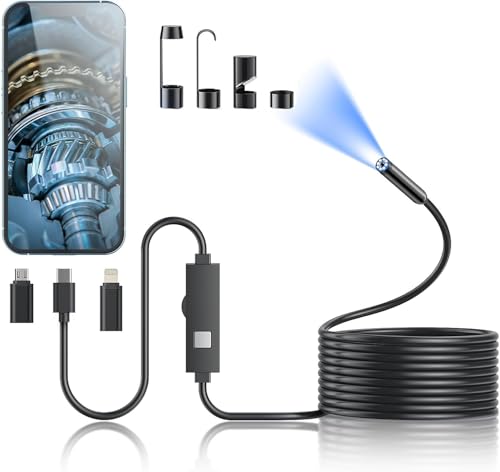
Kinpthy’s borescope offers 1920P clarity with a 7.9mm probe and a semi‑rigid 16.4ft cable. It emphasizes easy app connectivity for iOS/Android devices, including quick real‑time viewing. The IP67 waterproof design lets you inspect moist or submerged areas. Best for field techs who want a long probe and reliable app pairing without complex setup.
Who it’s best for: professionals with mobile devices who need straightforward, real‑time imaging. Why selected: strong connectivity and waterproof robustness. Caution: app setup guidance may vary by device and OS version.
Teslong USB‑C Endoscope With 8 LEDs

This USB‑C borescope emphasizes compatibility with a wide range of devices, including iPhone, Android phones, and tablets. It uses eight high‑intensity LEDs for dim environments and relies on a straightforward plug‑and‑play workflow with an accompanying app. Best for users who want a universal, smartphone‑centric inspection tool without a built‑in display.
Who it’s best for: mobile‑device users seeking broad compatibility and simple operation. Why selected: USB‑C convenience and reliable illumination. Caution: relies on app quality and phone compatibility rather than a built‑in screen.
AukonVee 4.3″ IPS Screen Endoscope

AukonVee pairs a 4.3-inch IPS display with eight LEDs and a 16.5ft semi‑rigid cable. The built‑in screen eliminates the need for a separate device and provides quick, real‑time viewing. IP67 waterproofing supports inspections in damp spaces. Best for users who want an all‑in‑one handheld solution for on‑site checks.
Who it’s best for: technicians who prefer an integrated display and direct control. Why selected: clear screen, long flexible reach, and rugged build. Caution: larger screen may reduce overall probe diameter tolerance in ultra‑tight spots.
KOMSHINE KIP-600V Fiber Optic Probe

The KOMSHINE KIP-600V provides a 400x magnification real‑time video view on a 3.5-inch LCD, combining high detail with a compact form. It records to a TF card and supports long operation with a 4,000mAh battery. Best for professionals who need high magnification and on‑site video capture for documentation.
Who it’s best for: inspectors requiring high detail and built‑in recording. Why selected: strong magnification and standalone data capture. Caution: larger file sizes may require memory management and card capacity planning.
Buying Guide: Mini Fiber Optic Cameras
- What matters most: display options (built‑in screen vs. smartphone), probe diameter, and cable length. Choose based on space access and workflow requirements.
- Resolution and lighting: 1920P/HD sensors with 8 LEDs help reveal cracks and moisture. For very tight spaces, a thinner probe diameter is advantageous.
- Waterproofing and ruggedness: IP67 or better is recommended for damp or underwater inspections. Consider semi‑rigid cables for steering around corners.
- Connectivity: If you rely on phones, ensure your device supports the camera’s connection method (USB‑C, Lightning, or app‑based). Built‑in displays simplify setups but add bulk.
- Storage and recording: Standalone recorders or camera assemblies with TF card support let you keep evidence and measurements for reporting.
- Practical considerations: weight, battery life, and ease of cleaning are important for field use. Consider models with easy disassembly for cleaning in dusty or oily environments.
Frequently Asked Questions
- What is the typical probe diameter for these mini endoscopes?
– Most options hover around 3.9–7.9mm, with ultra‑thin variants available for very narrow spaces. - Do these cameras require a separate device to view images?
– Some models use built‑in displays; others connect to smartphones or tablets via USB or wireless apps. - Are these cameras waterproof?
– Many are IP67 rated, suitable for damp or submerged inspections for limited durations. - Can I record video or take pictures with these devices?
– Some models support real‑time viewing and TF card recording; others rely on app captures or built‑in memory. - Which features should I prioritize for automotive use?
– A slim, rigid or semi‑rigid cable, bright LEDs, and a reliable connection to your smartphone or built‑in display are key.