Best Motion Activated Infrared Cameras for Wildlife and Home Security
Discover top motion activated infrared cameras designed for wildlife watching, property surveillance, and outdoors scouting. This guide highlights five reliable models with 4K or 64MP capability, long trigger ranges, night vision, and solar or extended battery options. Each pick balances image quality, trigger speed, battery life, and ease of remote access via apps. Use the quick reference table below to compare core specs at a glance.
| Product | Brand | Key Strengths |
|---|---|---|
| MAXDONE Trail Camera | MAXDONE | Detachable solar panel, 6000mAh battery, app control |
| GardePro E5S Trail Camera | GardePro | 64MP images, 100ft night vision, fast trigger |
| VIDVIS WiFi Solar Trail Camera | VIDVIS | 64MP/4K video, solar power, fast trigger |
| MRSCRET WiFi Trail Camera | MRSCRET | 4K/60MP, hotspot WiFi, no glow night vision |
| Meidase P70 Trail Camera | Meidase | 64MP, 0.1s trigger, 100ft night vision |
MAXDONE Trail Camera Review
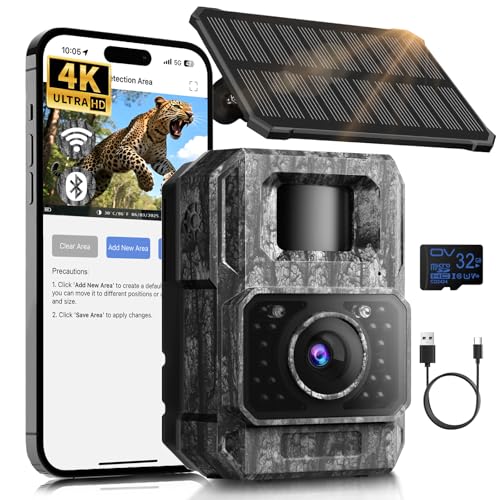
The MAXDONE Trail Camera combines a 6000mAh rechargeable lithium battery with a detachable solar panel, enabling flexible charging across seasons and terrains. It supports solar, Type-C, and battery power modes, letting users extend field life with minimal maintenance. The camera also features a user friendly app pairing via WiFi and Bluetooth, delivering photos and videos to a phone up to 55 feet away. Note that it creates its own hotspot, not a home Wi-Fi network, for remote access.
GardePro E5S Trail Camera Review

The GardePro E5S emphasizes image quality with a large f/1.6 aperture optical lens and a 64MP sensor, delivering crisp stills and HD video. It offers 100ft night vision and fast motion detection with a 0.1s trigger, plus a 90ft detection distance. The device records at 1296p and uses H.264 encoding for broad compatibility. Its robust build suits wildlife monitoring and hunting scenarios, with reliable daytime and nighttime performance.
VIDVIS WiFi Solar Trail Camera Review

The VIDVIS camera supports 64MP photos and 4K video, paired with 850nm low-glow night LEDs for clearer nighttime imagery at up to 65 feet. It features a rapid 0.2s trigger with 1–5 shot bursts and a PIR-based detection range up to 70 feet. Powered by solar and Type-C back-up, it offers flexible charging and long operation between battery changes, with dual power options to suit remote locations.
MRSCRET WiFi Trail Camera Review

The MRSCRET trail camera offers 4K video at 60MP photo capture, with a built-in 2.0-inch LCD screen for quick previews. It includes a 32GB SD card, 75ft nocturnal range, and a hotspot-style WiFi connection for remote access. The device emphasizes rapid 0.1s triggering and reliable nighttime performance, making it suitable for wildlife detection, property surveillance, and remote monitoring in harsh conditions.
Meidase P70 Trail Camera Review

The Meidase P70 delivers 64MP photos and 1296p HD video with a fast 0.1s trigger speed, designed to capture rapid wildlife movements. It employs 100ft no-glow infrared night vision for discreet nighttime recording and is built for rugged outdoor use. The camera’s advanced imaging helps preserve natural behavior in low-light conditions, emphasizing clarity and reliability for hunters and wildlife researchers alike.
Buying Guide
- Image quality and resolution: Look for 64MP photography and 4K video options for detailed records and clearer identification of subjects, especially in wildlife studies.
- Trigger speed and detection range: A fast trigger (0.1–0.2s) and long detection distance (up to 90ft) reduce missed moments.
- Night vision and no-glow: 940nm or similar no-glow infrared LEDs minimize disturbance to animals and improve nighttime image quality.
- Power options: Solar panels with rechargeable batteries offer longer field life; also consider USB-C or AA back-ups for reliability in extreme conditions.
- Connectivity: WiFi and Bluetooth apps enable remote access, status checks, and media transfer without removing memory cards; note whether devices operate as hotspots vs. home Wi-Fi clients.
- Durability and weatherproofing: IP ratings like IP66 ensure protection against dust and heavy rain; ensure the camera is built to withstand local climate and terrain.
- App ecosystem and data transfer: Assess app usability, video format compatibility (H.264/MP4), and whether cloud or local storage suits your needs.
- Storage and expansion: Check SD card capacity support and whether extra storage is needed for long deployments.
- Field maintenance: Detachable solar panels and easy battery swaps reduce maintenance; consider weight and mounting options for trails or property perimeters.
- 用途 alignment: Choose models tailored to wildlife monitoring, property security, or scouting, matching detection and video capabilities to your primary use case.