Best Portable LED Light for Video and Streaming
Answer: A portable LED light can dramatically improve video quality for on-camera work, livestreams, and conference calls. This guide highlights five compact, battery-friendly options that suit creators, professionals, and students needing reliable fill light on the go. The top picks cover a range from simple selfie lights to feature-rich panels with color and brightness control. The buyer’s guide below helps decide which model fits your setup and budget.
| Product | Best For | Key Benefit |
|---|---|---|
| ALTSON 60 LED Portable Selfie Light | Mobile creators and webcam users | High CRI 97+, versatile modes |
| ULANZI VL49 RGB Video Lights | Color-critical shoots and runs-and-gun setups | Full color control, LCD readout |
| NEEWER Basics 2 Pack LED Light Panel | Budget setups needing two panels | Bi-color, compact with stands and filters |
| NEEWER NL-116AI 9″ LED Panel | Studio-like lighting on the go | Precise temp/brightness, built-in battery |
| NiceVeedi 2-Pack Studio Light | Multi-light configurations for streaming | Three color temps, 10 brightness levels |
ALTSON 60 LED Portable Selfie Light

The ALTSON selfie light delivers a CRI of 97+ for natural skin tones, making it ideal for makeup, video calls, and quick vlogs. Best for mobile users who need a compact fill light with a 160° adjustable panel and a ¼-inch threaded adapter for cameras and tripods. It supports three light modes and ten brightness levels.
Best for: Mobile creators, students, and professionals needing a lightweight fill light for calls, photos, or on-the-go streaming. Limitation: Fewer color temperature options than larger panels; best used close to the subject.
ULANZI VL49 RGB Video Lights
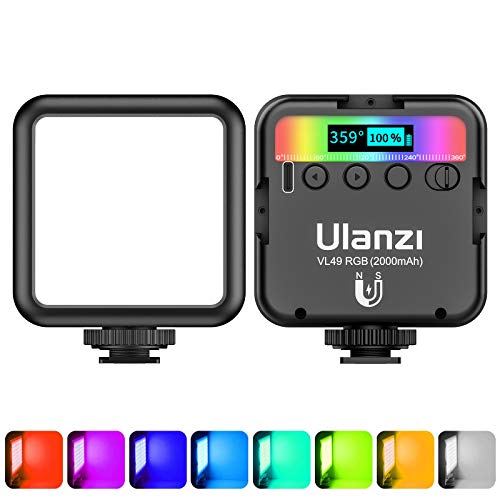
ULANZI VL49 provides 360° hue control with a color temperature range from 2500K to 9000K, plus a high CRI of 95+. A built-in LCD display helps with precise, on-the-fly adjustments. It runs on a 2000mAh rechargeable battery, supports USB-C, and can operate while charging—great for on-location shoots or late-night streams.
Best for: Creators who need accurate color rendering and adjustable hue for portraits, product shots, or run-and-gun video. Limitation: Battery life varies with brightness; longer shoots may require backup power.
NEEWER Basics 2 Pack LED Panel

This bi-color kit includes two 10W panels with 66 LEDs, offering 3200K to 5600K and CRI >95. It comes with stands and filters for soft light and a variety of looks. The remote control provides 10 brightness levels, suitable for makeup artists, streamers, and Zoom calls.
Best for: Budget-conscious setups needing two reliable panels with adjustable color and softening filters. Limitation: Carry bag not included, and higher-end color accuracy is limited to CRI >95 rather than higher-tier options.
NEEWER NL-116AI 9″ LED Panel

The NL-116AI offers a 9″ panel with 58 warm and 58 cool LEDs, delivering 600lux at 0.5m and a CRI of 95+. It includes a mini desk tripod, a USB-C port, and a 4000mAh built-in battery enabling up to about 1.5 hours of runtime. It supports 3200K-5600K color temp and is designed for portable studio setups.
Best for: Content creators needing a compact, battery-powered panel with adjustable temperature for interviews, vlogging, and desktop lighting. Limitation: Battery life is not extremely long on full brightness; consider lower brightness for extended shoots.
NiceVeedi 2-Pack Studio Light

NiceVeedi’s two-panel kit features three color temperatures (2800K, 4800K, 6500K) and 10 brightness levels controlled via remote. The 10″ light panels are compact, include diffusion, and come with a portable carrying bag for traveling setups, making them a versatile option for streamers and remote workers.
Best for: Streamers and vloggers who want flexible color temperatures and the convenience of a two-light kit for multiple angles. Limitation: The kit relies on external power or USB charging; battery-free use on location may require an adapter power source.
Buying Guide: Key Considerations For Portable Video Lights
- Purpose and environment: Are you filming indoors, outdoors, or on the move? Choose lights with battery power and compact form factors for portability, or larger panels with higher CRI for studio-like results.
- Color rendering: Look for CRI ratings of 95+ for natural skin tones. If color accuracy matters (makeup, fashion, product shoots), prioritize higher CRI and adjustable color temperature.
- Color temperature control: A range from warm (around 2500K) to cool (up to 9000K) offers flexibility across scenes and times of day. Bi-color panels simplify this choice.
- Brightness and diffusion: More brightness helps in bright environments or when shooting at a distance. Diffusion reduces harsh shadows and spots, producing softer light.
- Power options and battery life: Built-in batteries are essential for portability, but check runtime at different brightness levels. USB-C charging provides convenient recharging on-the-go.
- Mounting options: If you plan to mount on a camera, tripod, or desk, ensure the panel has compatible mounting threads and a stable stand or clamp.
- Controls and usability: LCD displays or remotes can simplify adjustment in dynamic shooting situations. Simpler panels may be best for beginners.
Frequently Asked Questions
- What is CRI and why does it matter? CRI (Color Rendering Index) measures how accurately a light renders colors compared to natural light. Higher CRI (95+ is common in these lights) provides more natural-looking skin tones and colors on camera.
- Do I need a bi-color light for video? Bi-color lights offer adjustable warmth and coolness, which helps match ambient light and achieve more flattering looks for varied environments.
- Is battery life important for video lighting? Yes. Longer runtimes reduce interruptions during shoots. Some lights allow use while charging for continuous operation.
- Can these lights be used with smartphones? Yes. Most models are designed to work with phones, tablets, laptops, and cameras, often via 1/4-inch threads and hot shoe compatibility.
- Should I buy two lights or one large panel? Two lights provide flexible angles and realistic fill, especially for livestreaming or interviews. A single larger panel can work well for desktop setups.
- How do I choose color temperature if I film in mixed lighting? Start with 5600K for daylight-mimicking conditions, then adjust toward warmer tones (3200K-4000K) to harmonize with indoor lighting.