Best Star Filters for Digital Cameras to Create Sparkling Night Shots
Answering the typical buyer’s search: star filters add dramatic, starburst highlights to bright points of light, ideal for night photography, jewelry, metalwork, and creative compositions. This guide highlights five strong choices suitable for a range of lens sizes, budgets, and shooting styles. Each option includes best-use scenarios, who it’s for, and practical considerations to help you pick with confidence.
The following table summarizes the featured products to help you compare at a glance. All selections support standard screw-on filter threads and are designed to produce distinct starburst effects with controlled brightness.
| Product | Thread Size | Best For | Key Benefit |
|---|---|---|---|
| Sedremm 77mm Star Filter (3pc) | 77 mm | Nightscapes, jewelry, glasswork | Brilliant 4/6/8-point star effects with solid build |
| K&F CONCEPT 49mm Variable Star Filter (4/8 Points) | 49 mm | Versatile creators, compact kits | Adjustable star lines for custom looks |
| K&F CONCEPT 58mm Variable Star Filter (4/8 Points) | 58 mm | Urban night shots, architecture | Clear color transmission with adjustable star lines |
| K&F CONCEPT 49mm Star Filters Kit (4/6/8 Points) | 49 mm | Starter to intermediate shooters | Three options in one kit for quick creativity |
| NEEWER 77mm Adjustable Star Filter (4/8 Points) | 77 mm | Street photography, jewelry, reflections | Rotatable design to switch between 4 and 8 points |
Sedremm 77mm Star Filter — 3 Pieces

Best for: photographers working with 77 mm lenses who want multiple star options. The set includes 4-, 6-, and 8-point stars, enabling varied creative intensity. The filter uses imported optics glass and resin for high transmittance and a metal sealing ring to reduce looseness. Choose this for dependable star bursts in night scenery, glasswork, and metallic subjects. A noted caveat is that the surface contains shallow marks that create the starburst pattern; avoid frequent wiping and store in a pouch to minimize dust. Confirm lens thread size before ordering.
K&F CONCEPT 49mm Variable Star Filter

Best for: compact kit owners who want flexible star intensity. This 49 mm variable star filter provides adjustable 4- or 8-point lines, letting you tailor the effect to shooting conditions. It uses an 18-layer coating for improved light transmission and reduced reflections, preserving a clear star effect. The trade-off is that adjusting star points may affect sharpness in extreme angles; test at different focal lengths to dial in the best balance. Suitable for night scenes, jewelry, and glasswork photography.
K&F CONCEPT 58mm Variable Star Filter
Best for: shooters with 58 mm lenses seeking a precise starburst without sacrificing clarity. The 58 mm version mirrors the 49 mm model’s 18-layer coating and adjustable star lines (4/8 points), offering crisp star effects while managing flare. It’s ideal for urban night photography, architectural highlights, and reflections in jewelry or glass. A limitation to consider is potential minor edge artifacts when shooting near strong light sources; use small apertures to minimize. This option pairs well with mid-size zooms and prime lenses alike.
K&F CONCEPT 49mm Star Filters Kit

Best for: beginners or practitioners who want a complete set in 49 mm. The kit includes 4-, 6-, and 8-point star filters, all with 18-layer coating to maintain clear light transmission. This arrangement lets photographers quickly switch between different star intensities for various subjects, from jewelry to architecture. A practical note: always verify thread size and handle gentle care to avoid surface scratches. The kit’s compact form supports travel-friendly setups for on-location shoots.
NEEWER 77mm Adjustable Star Filter
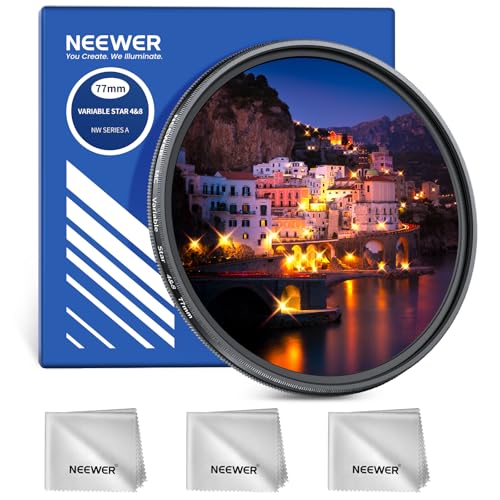
Best for: creative shooters who want dynamic control over starburst effects on 77 mm lenses. This rotatable filter converts between 4- and 8-point starlight by twisting the outer frame. It’s designed for night photography, jewelry highlights, and reflective surfaces. Multiple coatings protect against fingerprints and scratches, and three cleaning cloths are included for maintenance. A limitation is that rotating elements can slightly alter sharpness in high-contrast scenes; plan shots with stable tripod use to maximize consistency.
Buying Guide
- What thread size do you actually use? Always match the filter to your lens’ filter thread to avoid vignetting or fit issues.
- Do you prefer fixed or adjustable star effects? Choose fixed-point models for consistent results, or variable/rotating filters for creative flexibility.
- How does coating affect results? Look for multi-coating (18-layer) for higher light transmission and reduced reflections in night scenes.
- What subjects benefit most? Jewelry, glass and metal works, urban nightscapes, and reflections all respond well to starburst effects, especially with brighter highlights.
- What about care and durability? Metal rings and proper storage reduce loosening and dust, extending filter life in field use.
FAQ
- Do star filters reduce image sharpness? Some slight loss of sharpness can occur in high-contrast scenes; test at multiple angles and apertures to find a favorable balance.
- Are star filters compatible with all lenses? They are compatible with standard screw-on filters, but check thread size and compatibility with your lens’ front element.
- Which star-point option is best for beginners? Start with 4-point or 6-point settings before moving to 8-point for more dramatic effects.
- Do coated star filters resist fingerprints well? Multi-coated filters resist fingerprints and dust better, but cleaning should be done with care to avoid scratches.
- Should I use a tripod when using star filters? Yes, especially in low light, to maintain sharpness and prevent motion blur while adjusting the effect.
- Is it better to use a kit or individual filters? Kits offer cost-effective flexibility for testing multiple star effects, while individual filters suit targeted needs.