Best TVI to IP Encoder Solutions for Hybrid Security Systems
Answering the need for reliable TVI to IP conversion, this guide highlights five top encoders suited for different buyers—from small home setups to professional security installations. Each product section explains who it’s best for, why it was selected, and any practical limitations. This overview helps you compare compatibility, encoding efficiency, and ease of use without reinventing your existing camera investments.
Buyer summary table:
| Product | Best For | Key Benefit |
|---|---|---|
| Digital Watchdog DW-ENC4K16 16-Channel | Hybrid systems needing 4K clarity | 4K universal HD over Coax to IP |
| LQY0T BNC to IP Video Encoder | 4-in-1 camera compatibility | H.265, easy plug-and-play |
| LQY0T AHD2NET Analog to IP | Upgrade without replacing cameras | 1080P with dual streams |
| IPConverter Self-Adaption 1080P | 1080P BNC to IP conversion | Simple IP conversion for NVRs |
| HEVC Encoder URayCoder | Live streaming with multi-protocol | Multi-protocol outputs, 60fps |
Digital Watchdog DW-ENC4K16 16-Channel Encoder

The DW-ENC4K16 is designed for hybrid systems needing robust conversion from analog to IP. It supports up to 4K resolution, enabling ultra-clear video for surveillance environments that blend HD-TVI, HD-CVI, and HD-Analog cameras. This makes it a strong choice for security setups that require a single encoder to handle multiple analog formats. Best for mid-to-large installations that prioritize high-resolution streaming over constrained bandwidth.
Best for: larger facilities or professional sites where 4K video quality matters and multiple TVI/CVI/HD-Analog inputs must feed an IP NVR or VMS. A notable limitation is the potential need for network capacity to handle 4K streams across several channels.
LQY0T BNC to IP Video Encoder

This 4-in-1 encoder supports CVBS, AHD, CVI, and TVI, converting to IP via RTSP with H.265. Its plug-and-play design requires no software installation and integrates smoothly with mainstream NVRs. It’s ideal for small to medium setups where existing analog cameras across different formats must be unified into a single IP stream. A caveat: while efficient, real-world bandwidth depends on camera count and scene complexity.
Best for: users upgrading mixed-format analog systems who want a quick, network-friendly path to IP with solid H.265 efficiency. Better for smaller networks than very large deployments due to potential scaling considerations.
LQY0T AHD2NET Analog to IP Video Encoder

This encoder focuses on upgrading existing AHD, TVI, CVI, or CVBS cameras to IP with 1080P or 720P options. It uses H.265 or H.264 with dual streams for high-quality main feed and lower-bandwidth remote viewing. ONVIF and RTSP compatibility ensure broad NVR and software support. Ideal for facilities transitioning from analog to IP without a full equipment refresh. Limitation: default settings may require basic network configuration to ensure seamless connectivity.
Best for: those replacing old analog gear incrementally while maintaining reliable IP capture. Choose this if you need strong bandwidth savings without renaming your entire camera set.
IPConverter Self-Adaption 1080P AHD TVI CVI to IPC

This converter targets 1080P AHD/CVI/TVI cameras and turns BNC feeds into IP streams for NVRs. It’s compact and suitable for discreet placement behind cameras or in small junction boxes. Best for users who want a simple, low-profile IP upgrade for a single camera or a small group of cameras. A potential limitation is its 1080P focus, which may not satisfy higher-resolution requirements.
Best for: small-scale installations needing a straightforward, cost-effective BNC-to-IP solution. Choose this if 1080P is sufficient for your monitoring needs and you want a compact form factor.
HEVC MPEG4 H.265 H.264 HDMI to IP Encoder

The URayCoder encoder supports HDMI inputs and multiple streaming protocols, enabling live streaming to platforms and NVRs. It offers HEVC/H.264 dual encoding and multi-protocol outputs (RTSP, RTMP(S), SRT, HLS, UDP, etc.), making it suitable for professional live streaming and surveillance integration. Best for: users requiring flexible, multi-platform streaming with high efficiency. A limitation is that HDMI-only input excludes direct BNC-based camera ingestion without adapters.
Best for: professional setups where simultaneous streaming to several platforms and NVR compatibility are priorities. Choose this if your workflow includes live events or multi-platform broadcasts.
EXVIST H.265 1080P HDMI Video Encoder
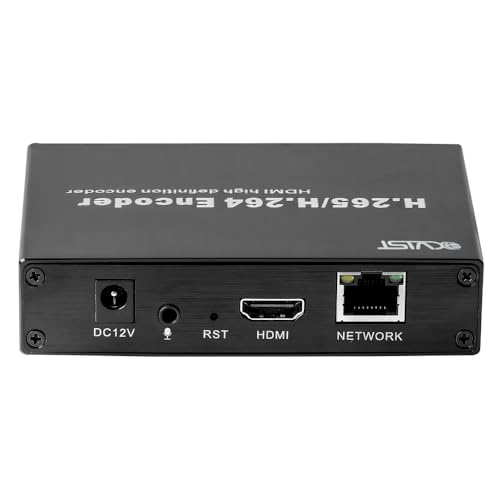
The EXVIST encoder focuses on HDTV-to-network conversion with 1080P input and supports RTSP, TS, and SRT. It uses H.265/H.264 compression for efficient bandwidth usage and is designed for CCTV surveillance and remote viewing. Best for environments relying on HDMI sources that want straightforward IP streaming. Limitation: urban deployments with variable network performance may need bandwidth management to avoid latency.
Best for: users migrating HDMI-based surveillance to IP with robust protocol support. Choose this if your source material is HDMI and you need flexible streaming options without extra hardware.
Wilxisum HDMI Encoder for IP Streaming

The Wilxisum HDMI encoder provides 1080P streaming with H.265/H.264 encoding and supports multiple streaming protocols, including SRT, RTMP, RTSP, RTMPS, UDP, and more. It enables live broadcasting to platforms like YouTube and Facebook while connecting to NVRs. Best for: live-broadcast-focused setups or distributed monitoring that requires broad protocol support and multicast/ unicast options. Limitation: some models note performance at higher resolutions or frame rates, so verify compatibility with your camera source.
Buying Guide
Key considerations when choosing a TVI to IP encoder:
- Video resolution and format compatibility: Match the encoder to your cameras (TVI, CVI, AHD, CVBS) and desired IP stream quality (1080P vs 4K).
- Encoding efficiency: Favor H.265/H.264 options to minimize bandwidth without sacrificing critical detail.
- Networking and protocols: Look for RTSP/RTMP/SRT/HLS support and ONVIF compatibility for broad NVR and software integration.
- Power and installation: Consider PoE options and the physical footprint for tight spaces behind cameras or in cabinets.
- Scalability: For larger systems, ensure the encoder supports multiple channels or can feed into a centralized NVR/VMS without bottlenecks.
- Future-proofing: If you plan 4K expansion, verify 4K input and 4K IP output capabilities.
FAQ
- What is the main purpose of a TVI to IP encoder?
To convert analog TVI/CVI/AHD signals into IP streams for network video recorders and management software. - Do these devices require advanced setup?
Many are plug-and-play or require minimal network configuration, though some may need IP addressing for NVR compatibility. - Is H.265 encoding better than H.264?
Yes, H.265 reduces bandwidth by about half compared to H.264 while maintaining quality at similar resolutions. - Can I upgrade all cameras at once?
Yes, many encoders support multiple camera formats, making a staged upgrade practical in mixed-format systems. - Will these work with standard NVRs?
Most encoders support ONVIF, RTSP, and RTMP, which ensures broad compatibility with common NVRs and VMS. - What is a good choice for a small business?
A compact, plug-and-play 4-in-1 encoder or a PoE-enabled AHD2NET option often provides the best balance of cost and capability.