Best Ultra High Speed Cameras for Fast-Mashion Analysis and Precision Capture
Answering buyers who need ultra high speed cameras for industrial inspection, 3D printing monitoring, motion analysis, and research projects. This guide highlights five top picks, explains who each is best for, and shows practical reasons to choose one over another. Ideal buyers include engineers, lab technicians, AI and vision system developers, and hobbyists working with high-speed processes.
The following table compares key aspects of the selected models to help you compare at a glance.
| Product | Max Frame Rate (approx) | Sensor Type | Best Use | Notes |
|---|---|---|---|---|
| IFWATER 640fps USB Camera Mono | 120fps at 1280×800; 210fps at 640×480 | 1/4″ OV9281 Global Shutter | Industrial motion capture, high-precision analysis | Monochrome for contrast |
| QILOVE Global Shutter USB Camera – 800P | 120-640fps (varies by resolution) | Monochrome CMOS with CS lens | Machine vision, rapid observation | Five to 50mm CS-mount lens |
| ELP High Speed USB Zoom Camera | Up to 230fps (1080P), 60fps-4K | IMX577 sensor | High-resolution live action, research | 10x zoom; USB3.0/2.0 |
| IFWATER Global Shutter Color USB3.0 Camera | 120fps (multiple resolutions), 200fps high frame rate | AR0234 color global shutter | Color high-speed capture, tooling, inspection | 2.3MP color sensor |
| Arducam VGA Global Shutter USB Camera Module | 800fps @ QQVGA | VGA monochrome global shutter | Metrology, motion analysis in compact form | Low-profile module; USB2.0 limitations noted |
IFWATER 640fps USB Camera Mono

Global Shutter Technology: This monochrome camera uses a global shutter to expose all pixels simultaneously, reducing rolling artifacts and distortion. It’s ideal for industrial inspection and high-precision scientific analysis where timing accuracy matters.
High-Speed Performance: Powered by a 1/4-inch OV9281 global shutter sensor, it delivers 1280×800 at 120fps MJPEG and 640×480 at 210fps MJPEG. Best for precise motion analysis and dynamic capture tasks.
4X Manual Zoom & Low-Light Clarity: A 2.8-12mm manual zoom lens provides flexible focal length control. The monochrome sensor improves contrast in engineering and research settings, especially under low light.
Who should consider this: engineers and researchers needing reliable high-speed, distortion-free monochrome video for quantitative analysis. Caution: monochrome output means color data is not available, which may limit some color-based analyses.
QILOVE Global Shutter USB Camera – 800P Monochrome

Adjustable High-Speed Recording: Supports 120-640fps with resolution-dependent tuning. Higher frame rates come at lower resolutions (e.g., 640×480 at 210fps, 160×120 at 640fps). This makes it versatile for analyzing rapid processes where detail is traded for speed.
Global Shutter for Clarity: The global shutter eliminates rolling artifacts, ensuring smear-free, distortion-free monochrome images during fast motion.
Monochrome Advantage: A monochrome CMOS sensor increases sensitivity and contrast in challenging lighting. It ships with a 5-50mm CS-mount lens that offers up to 10x optical zoom for flexible observation.
Best for: machine vision tasks where speed is critical and resolution can scale with frame rate. Choose this if you require adjustable speeds across multiple resolutions. Caution: color data is not available in monochrome mode, limiting some analyses that rely on color.
ELP High Speed USB Zoom Camera

Ultra HD And High Frame Rates: Records up to 1080P at 230fps and 4K at 60fps, with 3000P at 30fps. This enables smooth slow motion at standard resolutions and sharp 4K captures when needed. It supports multiple formats including YUY2 and MJPEG.
Flexible Zoom Versatility: A 5-50mm variable focus lens provides 10x zoom, letting users adjust distance without swapping lenses. This supports a wide range of indoor and outdoor shooting scenarios.
Platform Compatibility: Designed for Windows, Linux, Mac, Raspberry Pi, and more, making it suitable for PC-based workflows and embedded projects.
Best for: users needing high-speed, high-resolution footage with flexible zoom and broad OS support. Limitation: extremely high resolutions at peak frame rates may require powerful processing and storage.
IFWATER Global Shutter Color USB3.0 Camera
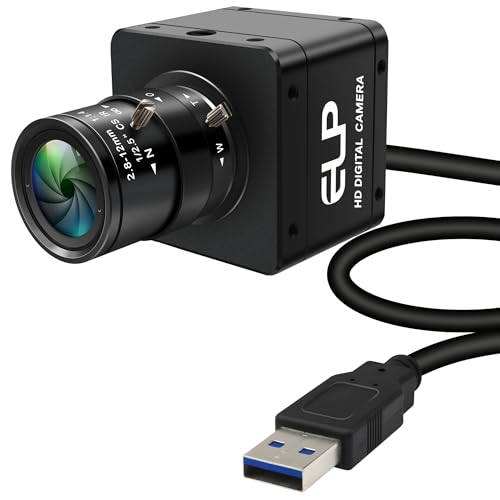
High-Speed Color Imaging: Equipped with a 1/2.6 inch AR0234 global shutter sensor, it captures up to 120FPS and 200FPS at higher frame rates across several resolutions. This makes it suitable for color-based high-speed analysis and color-sensitive observation tasks.
USB 3.0 Performance: USB 3.0 interface supports fast data transfer, with 1920×1200 max resolution and support for MJPEG and YUY2 formats. Stable frame rate output is maintained across USB 3.0 and USB 2.0 connections.
4X Zoom Lens: A 2.8-12mm 4X manual zoom lens allows flexible scene framing and distance coverage. It enables custom exposure control and sharpness for varied environments.
Best for: users needing color high-speed capture for quality control, inspection, and color-based motion studies. Caution: color sensors often have higher noise in low light compared to monochrome sensors.
Arducam VGA Global Shutter USB Camera Module

Global Shutter Mono And Ultra-High FPS: This VGA monochrome global shutter module exposes all pixels simultaneously, enabling precise motion analysis and high-speed inspection. It supports up to 800 FPS at QQVGA resolution.
Compact, Metrology-Ready Design: The small form factor suits lab setups, 3D printer monitoring, and controlled imaging tasks where space is a constraint. Note: software reporting limitations may apply due to USB2.0 device descriptor, while the camera can achieve higher true frame rates in preview.
Wide Angle Lens: A 166° lens provides a broad field of view, useful for larger scenes and metrology tasks. This makes it well-suited for lab environments and automated inspection systems.
Best for: measurements, timing experiments, and compact machine-vision projects where a high-speed, low-profile module is needed. Caution: actual reported frame rates may differ depending on software and USB bandwidth.
Buying Guide: Ultra High Speed Camera Essentials
- What frame rate do you need? Choose a camera based on the maximum useful fps at a resolution you will actually use. Higher fps often means lower resolution.
- Monochrome vs color. Monochrome sensors offer higher sensitivity and contrast in low light, while color sensors provide color information essential for some analyses.
- Sensor type and shutter. Global shutter prevents rolling artifacts in fast motion, which is critical for precise measurements.
- Lens options and zoom. Manually adjustable or varifocal lenses provide flexibility for observing different distances without multiple cameras.
- Interface and compatibility. USB 3.0 provides higher bandwidth than USB 2.0; ensure your PC or controller supports the camera’s data rate and formats.
- Size and form factor. For integrated systems, compact modules or mini cameras may be preferable to larger webcam-style units.
- Software and data workflow. Consider whether your application requires MJPEG or YUY2 compression, as well as how you plan to store and process the footage.
FAQ
- What is a global shutter, and why is it important for high-speed capture?
A global shutter captures the entire frame at once, preventing skew and motion blur during fast events. This is essential for accurate measurement and analysis of rapid motion.
- Can these cameras work with Raspberry Pi?
Yes. Several models in this list are designed for compatibility with Raspberry Pi and other platforms, often via USB interfaces and compatible drivers.
- Is monochrome always better for high-speed work?
Monochrome sensors typically offer higher light sensitivity and better contrast, which can improve clarity in high-speed imaging. Color sensors are preferred when color data is needed for analysis.
- How do I choose between 120fps and 640fps?
Choose based on the process speed and desired resolution. Higher fps generally requires lowering resolution to maintain stability and data throughput.
- What should I consider for lens choice?
Lenses with adjustable focal length (like 4X zoom) or fixed wide/narrow fields can adapt to different distances and scene sizes without swapping optics.
- Are these cameras suitable for 3D printing monitoring?
Yes. Several models are explicitly mentioned for 3D printer monitoring and related dynamic analysis, offering stable frame rates and suitable field of view.