Best Wide Angle L Lenses for Astrophotography
For night skies, dramatic landscapes, and star trails, a wide-angle lens with a fast aperture is essential. This guide compares top wide-angle options that shine in astrophotography, balancing sharpness, speed, distortion control, and build quality. Each pick is well-suited for different camera systems and shooting styles, helping you capture more stars with clarity and depth.
style=”display:none”>Overview Table
| Product | Camera Mount | F-Number | Notable Benefit |
|---|---|---|---|
| Rokinon 14mm F2.8 IF ED (Canon EF) | Canon EF | F2.8 | Ultra-wide field of view with solid astro performance |
| Canon RF16mm F2.8 STM | Canon RF | F2.8 | Bright fixed aperture with smooth AF for video and stills |
| Rokinon 14mm F2.8 (Nikon F) | Nikon F | F2.8 | Good edge-to-edge sharpness on Nikon systems |
| Samyang 24mm F1.8 AF (Sony E) | Sony E | F1.8 | Fast aperture and lightweight design for low-light work |
| Sony FE 16mm F1.8 G | Sony E | F1.8 | High resolution with smooth bokeh and minimal distortion |
Rokinon 14mm F2.8 IF ED Super Wide for Canon EF

The Rokinon 14mm F2.8 IF ED is a classic ultra-wide option ideal for astrophotography with Canon EF bodies. Its 14mm focal length yields a broad field of view, enabling expansive night-sky panoramas and dramatic landscapes. With a maximum aperture of F2.8, it performs well in low light for star fields and Milky Way shots. The lens includes a built-in Petal-type lens hood for reduced flare and a 0.9-foot minimum focusing distance for detailed foreground work. Its compact design and robust build support travel shooting and long exposures common in astro work.
Key features drive astro results: a wide 90° field of view on APS-C bodies, an F2.8 aperture for brighter star images, and a relatively short close-focus distance for foreground interest. Users should watch for edge softness at the frame corners and consider stacking techniques to control noise in longer exposures. The lens is weather-resistant in spirit, but care is advised in wet conditions.
Canon RF16mm F2.8 STM

The Canon RF16mm F2.8 STM is Canon’s compact ultra-wide fixed focal length option for the EOS R series. Its bright F2.8 aperture helps capture faint night skies with less noise, while the fixed focal length offers predictable perspective ideal for star fields and wide landscape shots. The STM motor provides smooth and quiet autofocus during video capture, making this lens versatile for astro videography or still photography. Its broad perspective helps compose sweeping skies with foreground interest, and its lightweight design reduces fatigue during long shoots.
Optimizing for astrophotography, this lens performs well for Milky Way arcs and star trails. Potential trade-offs include more pronounced distortion near the edges and a slightly narrower field than some 14mm peers, but its overall optical performance and video-friendly AF make it a compelling choice for Canon mirrorless users seeking simplicity and quality in one package.
Rokinon 14mm F2.8 IF ED (Nikon F)
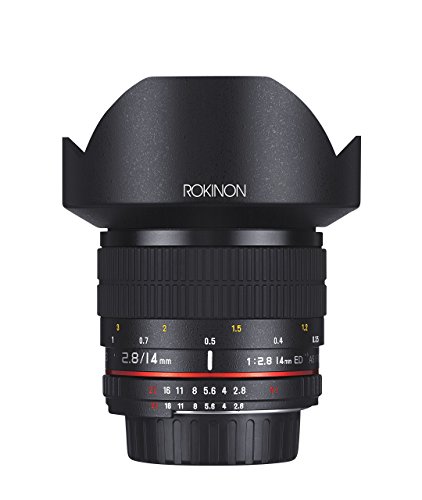
This Nikon F-mount version mirrors the classic 14mm wide angle with a fast F2.8 aperture. It offers a similar dramatic field of view to its Canon counterpart, useful for capturing expansive skies and foreground scenes. The lens has a minimum focusing distance around 10.8 inches, enabling creative foreground composition in nightscapes. While not zoomable, its fixed focal length provides consistent perspective and reliable sharpness across the frame, particularly when stopped down a touch for star field clarity.
Caution notes include handling to prevent water exposure and awareness of potential color fringing at extreme corners. Overall, the Nikon variant remains a strong entry point for astrophotographers using Nikon DSLR bodies, especially for those who value classic wide-angle performance without modern stabilization features.
Samyang 24mm F1.8 AF (Sony E)

The Samyang 24mm F1.8 AF for Sony E delivers a bright F1.8 aperture with a compact, lightweight design, ideal for astrophotography on Sony mirrorless cameras. Its 83.7° angle of view on full-frame Sony E bodies provides a wide scene encompassing star fields and landscapes. The linear STM autofocus system offers fast, silent operation suitable for both stills and video. A wide aperture helps reduce exposure times in dark skies, improving signal-to-noise ratios during long exposures. The lens is also appreciated for its 9-blade circular aperture, which enhances the quality of star points and background blur under brighter skies.
While designed for Sony E, users should account for potential coma near the extreme corners at the widest settings, particularly with star-rich scenes. Stopping down slightly or applying post-processing to mitigate aberrations can yield crisper star images while maintaining foreground detail.
Sony FE 16mm F1.8 G

The Sony FE 16mm F1.8 G is a compelling ultrawide option for Sony E-mount systems, combining resolution with a fast F1.8 aperture. This lens is designed to minimize field curvature and astigmatism with two AA elements, delivering sharp celestial details and clean star points across the frame. A short minimum focus distance enables close foregrounds, useful for sky-and-land compositions. Its compact form and high optical quality make it a favored choice for astro-landscape shooters who value both image clarity and portability.
Potential considerations include the balance between ultra-wide perspective and any distortion at the edges. For shooters who prioritize maximum brightness and color fidelity in low-light scenes, this lens offers a strong blend of performance and ease of use, especially when paired with high-ISO capable Sony bodies. It suits both astrophotography and everyday wide-angle shooting when required.
Buying Guide: Key Considerations For Wide-Angle Astrophotography Lenses
- Sensor compatibility: Choose lenses that cover your camera’s sensor size and mount (full-frame vs. APS-C). Wider angles are more dramatic on full-frame bodies, while APS-C users may experience a crop factor that changes perspective.
- Maximum aperture: A fast aperture (f/1.8–f/2.8) lets in more light, enabling shorter exposure times and reduced star trailing. However, ultra-wide primes at f/2.8 or f/1.8 still perform well with proper tracking or stacking.
- Sharpness and distortion: Look for good edge-to-edge sharpness and minimal distortion for astrophotography. Some lenses exhibit coma or distortion that require post-processing; weigh whether you’re comfortable with corrections in development.
- Autofocus vs. manual focus: For astrophotography, manual focus is often preferred due to dim scenes. Some modern lenses offer smooth, quiet AF suitable for video, but manual focus remains common for star fields.
- Build and weather sealing: Weather sealing helps protect gear in damp night conditions. Consider the lens’s physical durability if you shoot in challenging environments.
- Weight and balance: Lighter, compact lenses reduce fatigue during long sessions and are easier to pair with tracking mounts or tripods.
- Compatibility with astrophotography accessories: Ensure compatibility with filters, dew heaters, and the specific star-tracking equipment you use, if any.
- Field of view and composition: A 14–16mm range on full-frame offers expansive skies and dramatic foregrounds. For APS-C bodies, factor in crop to determine perceived field of view.
These lenses span several mounts and strengths, enabling you to tailor gear to your camera system and shooting style. For beginners, a fast ultra-wide prime around f/2.8 is a strong starting point. For more experienced astro-landscape shooters, faster primes (f/1.8) can reduce exposure times and improve low-light performance, especially when combined with tracking or stacking strategies. Always test for color fringing, sharpness, and coma in your typical night-sky scenes to choose the best match for your creative goals.