Best Wifi Module for Camera: Top 5 Hidden Cam Modules for Home and Office
The best wifi module for a camera is the one that fits your monitoring needs, power options, and concealment level. This guide highlights five top modules that balance compact design, reliable wireless connectivity, and flexible power or storage options. Ideal buyers include hobbyists building DIY surveillance, parents needing discreet monitoring, and small-business installers seeking off-grid or plug-in solutions.
Summary table of chosen products:
| Product | Best For | Key Benefit |
|---|---|---|
| HiSpyCam Mini Camera DIY Module HD 1080P | Discreet DIY projects and hidden surveillance | Ultra-compact with stable WiFi and SD optional recording |
| DIY Hidden Camera Module, Mini Spy Camera WiFi | Covert monitoring in everyday objects | Extremely small footprint and Bluetooth setup |
| InCliick 1080P WiFi Cameras Mini DIY Module | Versatile DIY camera for varied uses | Compact with USB power options and easy remote viewing |
| Cavitt Mini Spy Camera DIY Module – 2K | High-resolution home/office nanny cam | 2K clarity with wide-angle view and real-time app control |
| 2-Pack ESP32 CAM Development Board | Developers and makers building custom camera projects | Dual-core processing and flexible interfaces |
HiSpyCam Mini Camera DIY Module

The HiSpyCam module targets buyers seeking a tiny, easily concealed camera for DIY projects. It records in 1080p and supports remote viewing over WiFi; if the connection drops, it stores video on an SD card. This makes it suitable for discreet monitoring in homes or small offices where space is limited. Best for: hobbyists embedding a compact camera into decor or hidden enclosures. Limitation: no explicit mention of night vision in the listed features, so visibility in darkness may be limited.
DIY Hidden Camera Module, Mini Spy Camera WiFi for Inside Home

This ultra-compact module emphasizes covert placement, boasting a micro footprint and Bluetooth setup that simplifies pairing with a phone app. It supports 1080p live viewing via 2.4 GHz WiFi and offers a local loop recording mode using a Micro SD card (not included) even without WiFi, which is useful for off-grid monitoring. Best for: environments where stealth and quick setup matter. Limitation: does not support 5 GHz WiFi and specifies daylight use, with no night vision claimed.
InCliick 1080P WiFi Cameras Mini DIY Module

InCliick offers a 1080p mini camera suitable for DIY surveillance with remote viewing over 2.4 GHz WiFi. It emphasizes USB power or battery bank powering and a DIY-ready design, allowing installation in various objects or portable setups. Best for: users who want a flexible power solution and easy app access. Limitation: no built-in audio recording due to privacy policy, and no battery included.
Cavitt Mini Spy Camera DIY Module – 2K Ultra HD

Cavitt targets higher-detail monitoring with 2K resolution and a 140-degree wide field of view. It supports app control via Tuya Smart, with live streaming and motion alerts, plus SD card and cloud storage options. This makes it suitable for home or small-office surveillance where broader coverage and clearer video are priorities. Best for: users needing sharper footage and wider coverage. Limitation: the data notes Tuya-enabled control, which may imply reliance on a cloud platform for some features.
2-Pack ESP32 CAM Development Board
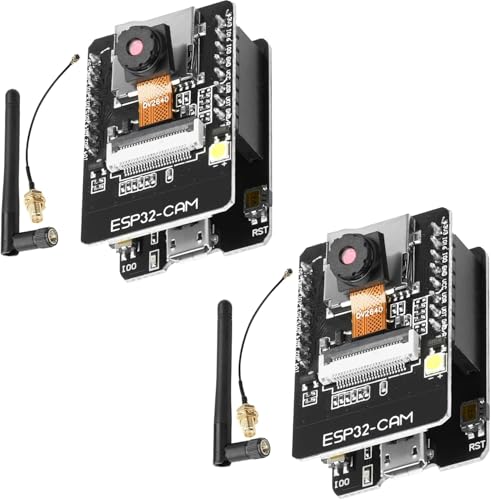
This dual-core ESP32 CAM module is designed for developers and makers building custom camera solutions. It supports WiFi and Bluetooth/BLE, offers multiple interfaces (UART, SPI, I2C, PWM, ADC/DAC), and is compatible with various camera sensors. Best for: technical users creating tailored surveillance or analytics projects. Limitation: not a plug-and-play consumer camera; requires technical setup and programming knowledge, plus external power and storage choices.
Buying Guide: Key Considerations For Choosing a Wifi Camera Module
What level of concealment do you need? If the goal is near-invisible placement, ultra-compact DIY modules like the HiSpyCam or VIULISECTY variants can blend into everyday objects. For higher-resolution surveillance with a wider field of view, Cavitt’s 2K module offers sharper detail and broader coverage.
Power and storage options matter. Some modules run on USB power or battery banks, while others rely on WiFi with SD card storage. Consider whether off-grid operation (no WiFi) is essential, which is where Micro SD-based loop recording can help, as in certain DIY modules.
Connectivity and compatibility. Most modules use 2.4 GHz WiFi; note that some do not support 5 GHz networks. If you plan to integrate with a larger ecosystem or NVR, a module like the eufy Wi‑Fi Module (for NVR systems) demonstrates how an ecosystem helps unified control. For developers, ESP32 CAM provides deep customization but requires technical setup.
Video quality versus practicality. 1080p modules are common for everyday monitoring, while 2K or higher resolutions offer crisper footage but require more storage and bandwidth. Consider your lighting conditions; some modules state daylight performance but lack night vision, which affects usability in dark spaces.
Privacy and compliance. Ensure audio policies and recording practices align with local laws. Some listed devices emphasize video-only capture or restrict audio, which is important for ethical and legal use.
Frequently Asked Questions
- What is a wifi module for a camera? A compact hardware unit that provides wireless connectivity to a camera, enabling remote viewing, control, and sometimes local recording via SD storage.
- Do all modules support 5 GHz WiFi? No. Several listed modules operate on 2.4 GHz networks, which can affect range and interference options.
- Is night vision common on these modules? Some models emphasize daylight use; night vision may be unavailable or require additional components.
- Can I use these modules without WiFi? Many offer a local recording mode or direct hotspot access, allowing offline monitoring when WiFi is unavailable.
- Are these suitable for DIY beginners? Modules like the ESP32 CAM are better suited for developers; simpler plug-and-play options exist but may still require setup.
- What should I consider for privacy? Choose modules with clear data handling, use secure app connections, and follow local surveillance laws when deploying hidden cameras.