Best Bike Rider Cameras for Safer Rides
Answering the needs of road and trail cyclists, this guide highlights five reliable cameras designed for bike riders. These options emphasize rear visibility, wide-angle views, long battery life, and durable builds for various weather conditions. Ideal buyers include daily commuters, weekend road cyclists, mountain bikers, and e-bike users who want better awareness without constantly turning their heads. Below is a quick buying table followed by in-depth product sections and a comprehensive buying guide.
| Product | Best For | Key Benefit |
|---|---|---|
| FEISIKE Handlebar Bike Mirror | Everyday commuting | Real-time rear view and 145° wide-angle |
| Fitense Bike Camera (10000mAh) | All-weather rides | Long battery life and IP67 rating |
| Fitense Bike Camera (5000mAh) | Budget-friendly long rides | Long battery life and 4.3″ display |
| ATOVANKA Bicycle Rear View Camera | E-bike and city riders | Four view modes and 10-hour battery |
| PARKVISION Handlebar Bike Mirror | Trail and mountain riders | Adjustable wide-angle preferences and AI-ready brightness |
FEISIKE Handlebar Bike Mirror Review

The FEISIKE model provides a real-time rear-view mirror with a 4.3-inch HD display. Its 145-degree wide-angle camera helps riders spot approaching vehicles without turning their neck, making it best for daily commuters who ride in mixed traffic and urban environments. The adjustable bracket fits 20–30 mm handlebars, and a long 78-inch cable supports versatile installation on most bikes. Note that cable length could be a limitation for some frame layouts.
Who it’s best for and why
- Best for commuters who want a simple, integrated rear-view solution without extra cameras on the helmet or helmet-mounts.
- Best for riders prioritizing a larger screen for easier viewing at a glance while stopped or slowly moving.
Limitations
- Cable length may require an extension on certain bikes; verify your frame geometry before purchase.
Fitense 10000mAh Bike Camera With Battery Power
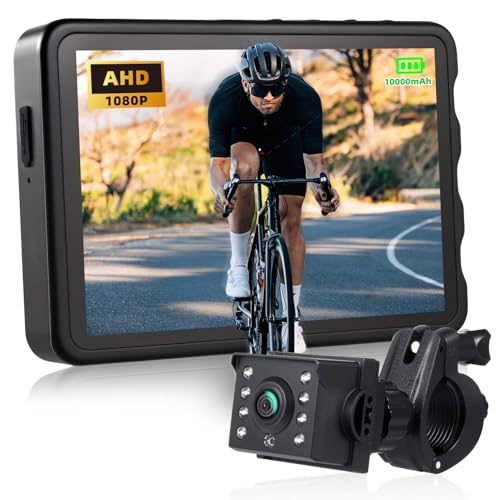
This camera system centers on endurance with a 10000mAh rechargeable battery and IP67 weather resistance. It offers a 360° rotation stand and a 5-inch display with 1080P resolution, supporting 130°, 110°, and 100° wide-angle settings to minimize distortion. The long battery life (10–12 hours typical use) makes it ideal for longer rides or daily commutes where charging opportunities are limited. It fits 20–30 mm handlebars and includes multiple mounting options for flexible installation.
Who it’s best for and why
- Best for riders who need extended operation between charges, such as weekend tours or multi-day rides.
- Better for those who want a larger screen and adjustable angles to suit various road conditions.
Limitations
- Battery life varies with display brightness and camera usage; heavier brightness reduces runtime.
Fitense 5000mAh 4.3″ Display Bike Camera

This model emphasizes a compact 4.3-inch display with 1080P recording and an IP67 rating for weather resistance. The 130°/110°/100° adjustable wide-angle views maintain a distortion-free image, and a 5000mAh battery supports several hours of use. It suits riders who want a mid-sized display and straightforward setup on standard handlebars. Its USB-C connectivity enables quick recharging and easy power cycling during long rides.
Who it’s best for and why
- Best for riders who prefer a smaller, lighter unit on standard handlebars without sacrificing image clarity.
- Better for those who value a balance between screen size, camera angle options, and weather resistance.
Limitations
- May not offer as long a runtime as larger-capacity models under heavy brightness or recording settings.
PARKVISION Handlebar Bike Mirror With Zoom

PARKVISION offers a 4.3-inch HD monitor with multiple viewing angles and an impressive 10-hour battery life, making it suitable for longer rides or tours. The rear-view options include 120°, 100°, 80°, and 60° to tailor visibility to road conditions, helping riders gauge distances more accurately. Automatic brightness adjustment enhances legibility in bright sun or low light. The unit supports an extended runtime and robust field-of-view customization for mountain and city riders alike.
Who it’s best for and why
- Best for riders who want flexible angle presets to adapt to different terrains and traffic densities.
- Better for mountain bikers who require a strong field of view at varying speeds and conditions.
Limitations
- Higher-end modes may consume more battery; plan charging around long rides.
Buying Guide
What to look for in a bike rider camera
- Field of view and distortion: Prefer cameras offering wide-angle views with minimal distortion, typically 130°–150°.
- Display size and readability: A larger display helps at a glance; however, balance with overall unit size and weight.
- Battery life: Look for 7–12 hours of real-world operation for daily commutes and tours; check charging time and USB-C compatibility.
- Weather resistance: IP67 or higher ratings ensure operation in rain and splashes; consider waterproof housings for submersion exposure.
- Mounting versatility: Ensure compatibility with 20–30 mm handlebars and multiple mounting options for forks, stems, or helmets as needed.
- Video quality and storage: 1080P is common and reliable; higher-end 4K adds detail but may tax batteries and storage.
- Ease of use: Quick power on/off, simple modes for switching viewing angles, and intuitive interfaces help maintain safety on the move.
Angle options vs. road conditions: how to choose
For urban riders with heavier traffic, a fixed 145°–130° field of view minimizes blind spots while maintaining depth perception. For mountain riders or fast-paced sport bikes, adjustable 120°–60° settings allow focused rear observations when needed and wider coverage during slower sections.
Installation considerations
- Check handlebar diameter compatibility (20–30 mm is common). If your bar differs, you may need adapters or different brackets.
- Cable length matters; longer cables enable more flexible placements but can create clutter.
- Weather seals and mounts should be checked regularly to avoid rattles or loosening on rough trails.
Maintenance and care tips
- Regularly clean the lens and display to prevent glare and ensure clear visibility.
- Inspect mounting hardware after rugged rides to prevent camera shifts or detachments.
- Test battery and backup power options before long trips to avoid unexpected shutdowns.
FAQ
- Do these cameras require an internet connection to function? No. These devices typically operate offline, with some models offering optional app-based live view when connected via WiFi or Bluetooth.
- Can I use these cameras on a helmet instead of the handlebar? Some models support helmet mounts, but installation must be secure and within local laws about helmet-mounted cameras.
- Is 1080P enough for rear visibility footage? Yes, 1080P provides clear rear footage for identifying vehicles, with 4K options available on select models for more detail.
- Will the camera drain my bike battery? These cameras generally run on their own battery; when powered by the bike’s USB or an external pack, ensure there is no interference with bike electronics.
- What if the camera fogs up in rain or cold? Look for IP67-rated devices and consider anti-fog lenses or protective housings for extreme conditions.
- Are there red flags with mounting on moving parts? Ensure mounts are tight and do not obstruct steering or gear shifting; avoid loose cables near rotating parts.